


The Need for Fascism in Britain (Nesta Webster)
Source Overviews
All of the text sources are authored by Nesta Webster.


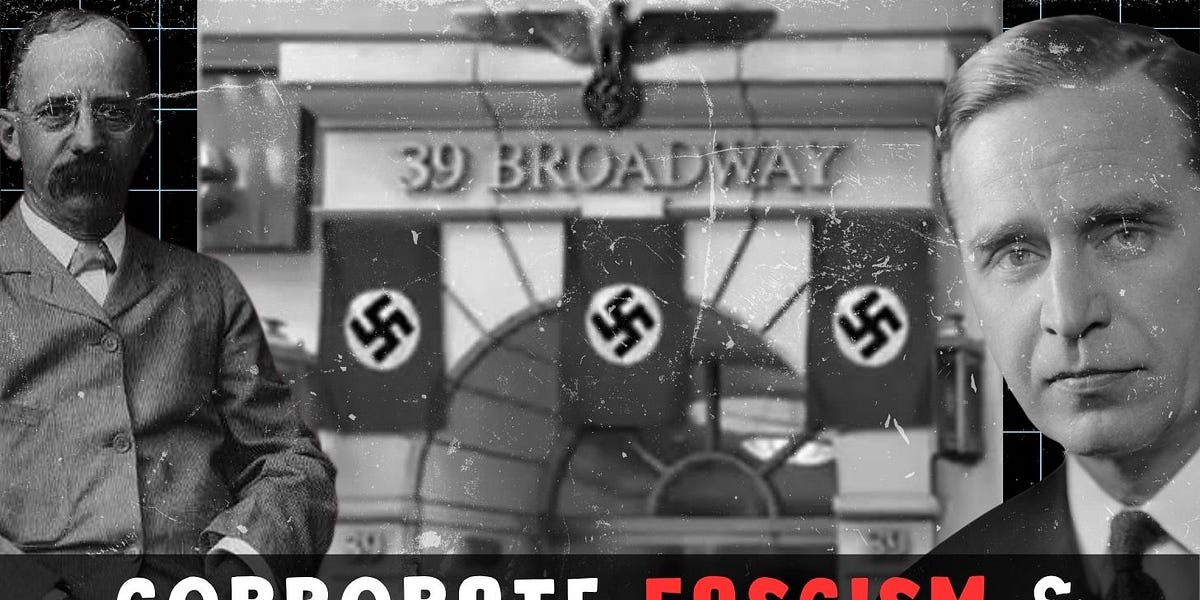
The HQ of the Union Bank Corp & Brown Brothers Harriman, Primary Financial Backer of the National Socialist Party of Germany
The Need for Fascism in Britain (1926)

In this 1926 pamphlet, Nesta Webster argues that the British Fascists provide the only disciplined and "virile" solution to the perceived threat of Bolshevism and the perceived incompetence of the Conservative government. She characterizes Fascism as a natural, defensive biological response—likening its members to white blood cells—that must be organized in advance to prevent a violent revolutionary "Red Terror." By critiquing mainstream politicians for their apathy and concessions to Socialism, Webster calls for a movement based on counter-intimidation and patriotic service to capture the imagination of the nation's youth. Ultimately, the text serves as a formal declaration of her allegiance to the organization, urging fragmented anti-socialist groups to unite under a militant banner to preserve the British Empire through disciplined action.
The Socialist Network (1926)
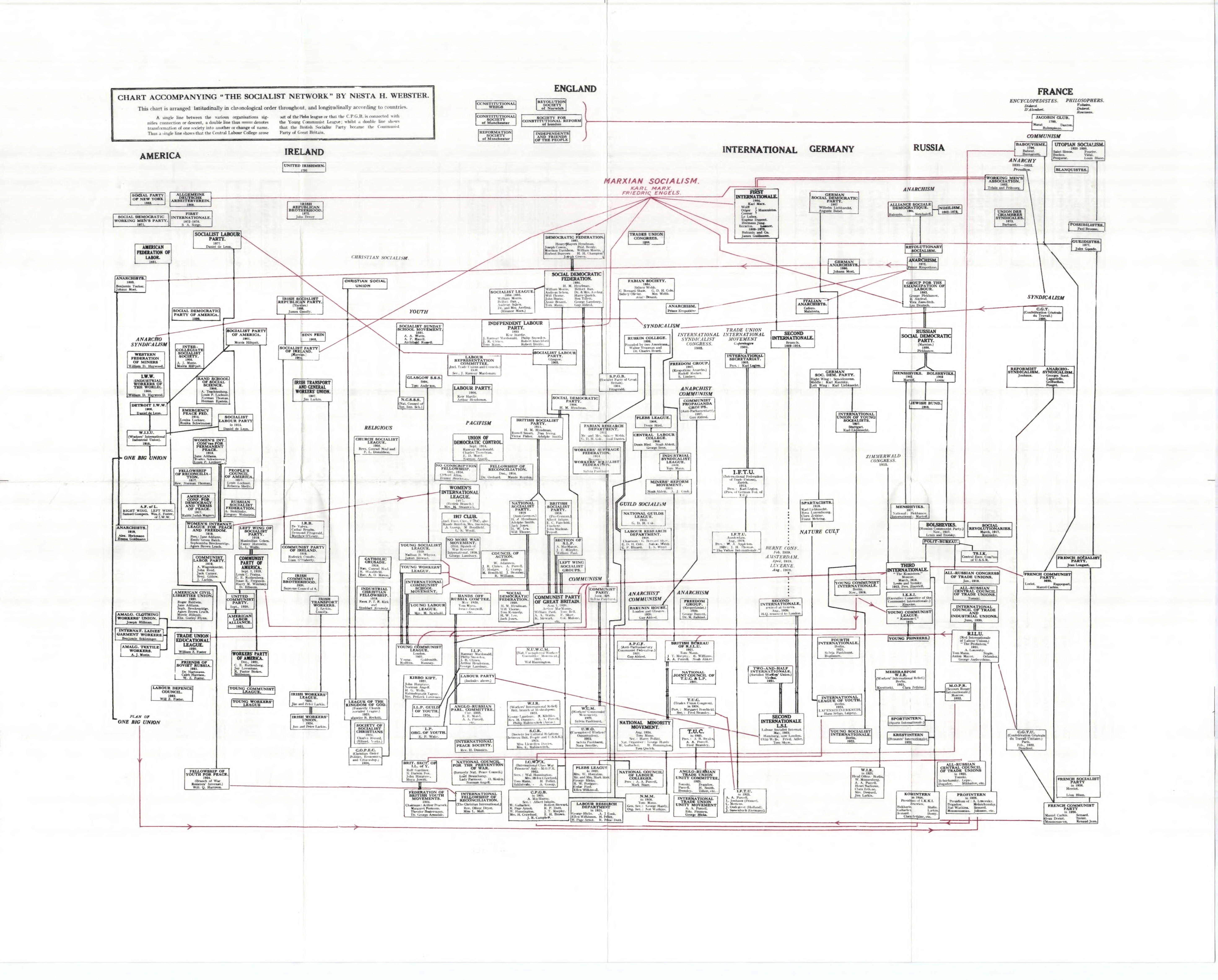 Direct Link: https://files.catbox.moe/isrg5t.png
Nesta Webster’s text provides a detailed genealogical history of the modern Socialist movement, arguing that it represents a continuous revolutionary thread dating back to the eighteenth century rather than a series of disconnected uprisings. The author meticulously categorizes the ideological fractures within the movement, specifically contrasting the Marxian objective of state control with the Anarchist drive for total state abolition. By tracing the evolution of various "Internationales" and the rise of Bolshevism, the work explores how radical factions utilized pacifist propaganda and labor unions to advance their agendas during and after the Great War. Ultimately, the text serves as an alarmist map of a vast network of subversive organizations, claiming that diverse social, religious, and youth groups are interlinked under a centralized revolutionary command aimed at dismantling the existing social order.
The Surrender of an Empire (1931)
In her 1931 historical and political critique, Nesta Helen Webster chronicles what she perceives as the systematic disintegration of British global prestige following the Great War. The text functions as a multifaceted indictment of liberal pacifism, socialist infiltration, and clandestine international influences that Webster believes sapped the "national consciousness" and led to a "surrender" of hard-won imperial rights. Structured as a chronological and thematic investigation, the work spans from the origins of the Great War to the post-war uprisings in India, Egypt, and Ireland, consistently arguing that concessions to seditious agitation only served to embolden the enemies of the Empire.
A primary theme of the book is the menace of Bolshevism, which Webster depicts not as a spontaneous working-class movement but as a destructive force backed by international finance and German militarism. She expresses profound alarm at the "Hidden Hand" of subversive elements—including Freemasonry, secret societies, and the League of Nations—which she contends worked to establish a universal republic at the expense of British sovereignty. By detailing the rise of the "Die-Hard" revolt and the failures of leaders like Lloyd George, Webster highlights a perceived paralysis of statesmanship where British rulers chose to "placate revolutionaries" rather than defend national interests with traditional vigor.
Ultimately, the source serves as a call to national action against the "suicidal tendencies" of contemporary governance. Webster rejects the notion of British decadence, insisting instead that the Empire’s decline was an artificial collapse engineered by men in control who lacked the courage to confront the "forces of disruption." Through a lens of deep-seated anti-socialism and nationalism, she explores how the abandonment of loyalists and the rise of "Swaraj" in India represent a broader pattern of imperial retreat that she views as an avoidable tragedy.
See Also
Expand for Links



Documentary Everything is a Rich Man's Trick
The Hidden Hand Behind Britain's Decline: What Suppressed History Reveals
In 1930, Winston Churchill gave voice to a profound anxiety gripping the nation, observing that “some spring seems to have snapped in the national consciousness. There is a readiness to cast away all that has been won by measureless sacrifices.” An empire that stood triumphant just over a decade earlier now seemed adrift, seized by a sense of powerlessness. But was this collapse of will an accident of history—the inevitable fatigue of a great power? Or was it the result of a deliberate, sustained, and shockingly successful campaign waged against the British Empire, not only from without but from deep within its own corridors of power?
The official histories are incomplete. Our investigation, drawing on suppressed contemporary analysis, uncovers a startling paper trail. The evidence proves that Britain’s decline was no accident, revealing a hidden history in which:
- Pre-war British leadership, through a policy of pacifism and willful blindness, all but invited German aggression, ignoring clear warnings from its own military visionaries.
- The Great War effort was systematically undermined by a network of saboteurs, pacifists, and powerful financial interests referred to by insiders as the “Hidden Hand.”
- The hard-won victory of 1918 was sabotaged at the peace table by speculative internationalist schemes and the influence of international financiers that protected a defeated Germany.
- The rise of Bolshevism was not a popular uprising but a meticulously executed German intelligence operation, and its unchecked spread into Britain necessitated a new and militant form of patriotism to defend the nation where the government had failed.
From the Great War to the present, the historical record shows that Britain's most formidable enemies have not been foreign armies, but as the historian Nesta Webster warned, "our worst foes have been those of our own household."
1. The Seeds of Surrender: Britain Before and During the Great War
To understand how the peace was lost, one must first uncover how the war was almost lost—not on the battlefields of Flanders, but in the cabinet rooms and union halls of Great Britain. Long before the Treaty of Versailles was signed, a rot had set in. The nation's vulnerabilities were not just exposed by war; they were actively exploited by a confluence of political idealism, ideological subversion, and hidden financial allegiances that paralyzed the country's ability to defend itself.
The Spark: Pacifism's Price
The official histories tell you the Great War was an outbreak of irrational militarism. The suppressed evidence shows the opposite: it was "pacifism on the part of our politicians" that hastened the conflict. For years, military leaders like Lord Roberts had campaigned tirelessly for National Service, delivering prophetic warnings such as, "Germany strikes when Germany's hour has struck." His words, however, were dismissed by the political establishment as crude warmongering.
Instead of preparing, leaders like Lord Haldane, Mr. Asquith, and Mr. Lloyd George delivered "reassuring" and "conciliatory" speeches. In January 1914, Lloyd George declared the time was right to reduce naval expenditure. Lord Haldane spoke of relations with Germany being "twice as good" as they were two years prior. Germany, however, interpreted this attitude not as a gesture of peace, but as "pure hypocrisy" and a sign of terminal weakness. As the French Ambassador M. Jules Cambon argued at the time, a firm declaration of Britain's intent to stand with France would have decided the "German attitude in favour of peace." Instead, Britain's leaders projected weakness, and Germany, seeing an open door, marched through it.
The War Within a War: Sabotage on the Home Front
Once war began, our investigation finds the battle for Britain's survival was compromised by a series of "unaccountable incidents" that systematically weakened the war effort from within. These were not isolated mistakes but a pattern of behaviour that suggests a powerful, unseen influence was at work.
- Alien Enemies: At the outset of the war, the government inexplicably allowed German reservists days to return home to fight for the Kaiser. In effect, Britain presented its enemy with "an Army Corps from England." The government went further, forbidding the Navy from capturing reservists from other countries en route to join the enemy.
- Delayed Conscription: For nearly two years, conscription was blocked by Liberal and Socialist opposition. This delay ensured that the pick of England's manhood—the volunteers—was decimated in the opening slaughter, while others were free to earn enormous pay of up to £12 a week in munition factories.
- Munitions Shortages: At the front, soldiers sent a desperate plea: "More shells and more high explosive shells." Yet on the home front, output was deliberately restricted by Trade Union regulations and what contemporary reports called the "selfish interests of Labour organisations." Despite direct appeals from the front, these restrictions were allowed to continue, costing countless lives.
- The "Hidden Hand": So persistent were these acts of sabotage that the theory of a "Hidden Hand" gained widespread currency, not just among the public but at the highest levels. Lord Wittenham spoke of the “subtle, indescribable influence which, whenever he wanted to be bold, seemed to paralyse” the Home Office. Lord Beresford was more direct, attributing this influence to the "power of the international financiers," who were believed to be protecting German interests and shielding enemy agents like the naturalised Trebitsch Lincoln (an ex-Liberal MP later discovered to be a German spy) and Sir Edgar Speyer (a Privy Councillor whose baronetcy was revoked for disloyalty and communicating with the enemy).
This internal decay, which plagued Britain throughout the war, did not end with the Armistice. Instead, the same forces that had hampered the military effort pivoted to ensure that the subsequent peace would be even more disastrous than the war itself.
2. The Core Intrigue: How Victory Was Lost and Revolution Unleashed
The ceasefire of November 11, 1918, was not the end of the struggle; it was merely a repositioning of the front line from the fields of France to the negotiating tables of Paris. The very forces that had worked to weaken Britain's war machine now focused on a new, twofold objective: first, to strip the Allies of their decisive victory, and second, to import a revolutionary virus engineered in the war rooms of their defeated enemy—Bolshevism.
The Architects of a Lost Peace
The fruits of a victory won with nearly a million British lives were squandered with breathtaking speed. The primary instrument of this sabotage was the idealistic framework imposed upon the Peace Conference by U.S. President Woodrow Wilson. His "Fourteen Points" and the proposal for a League of Nations were hailed as enlightened diplomacy, but in reality, they were what Winston Churchill himself later described as "an Anglo-Saxon conception," a framework that played directly into Germany's hands by preventing a conclusive, practical peace.
The "supreme error" was the decision to incorporate the League of Nations Covenant directly into the Treaty of Versailles. This hopelessly entangled straightforward peace terms—reparations, security, and borders—with a speculative, internationalist scheme for preventing all future wars. The result was chaos. Field-Marshal Sir Henry Wilson, present at Versailles, described a surreal scene where statesmen were forced to sign a treaty that "does not exist" in its completed form. So profound was the confusion that A.J. Balfour, one of the signatories, was heard "openly joking in front of the ladies... about the farce of the whole thing." An instrument designed to secure world peace had become a punchline, one that disarmed the Allies while allowing Germany to evade its responsibilities.
The Bolshevist Virus: A German Operation
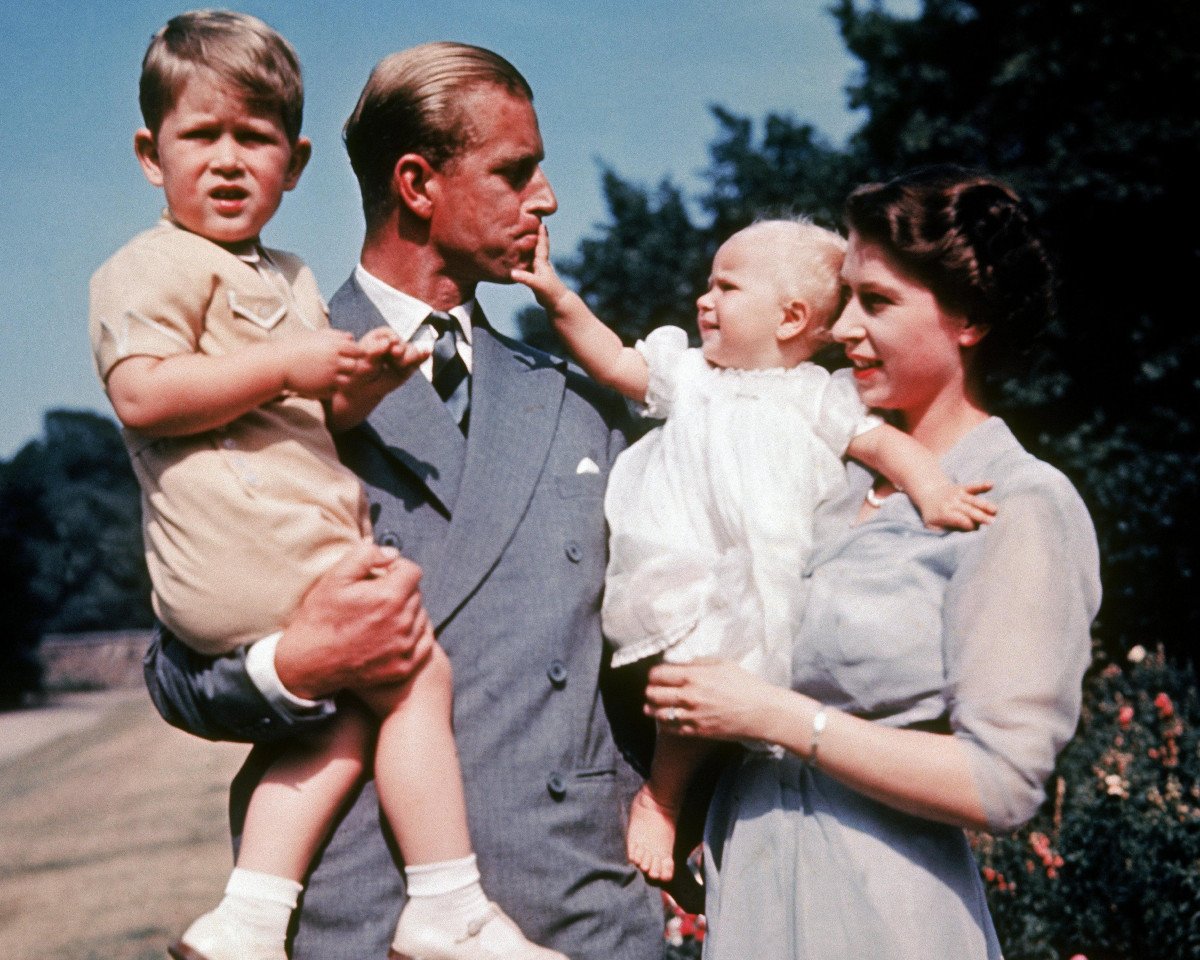
Important Note on Prince Philip
Communism was seen as an aggression against the Royals of Europe (as the murder of the Tsar & and family was a warning to the royals of Europe who were directly related to the Tsar)

Prince Philip says that: https://www.express.co.uk/news/royal/1422081/boris-johnson-prince-philip-death-news-duke-of-edinburgh-latest-house-of-commons-royal-vn
"Prince Philip’s ancestor Queen Victoria and her husband Prince Albert of Saxe-Coburg and Gotha, whose great-grandfather Ernst II of Saxe-Gotha-Altenburg gave refuge to Adam Weishaupt, founder of the Illuminati."

"Prince Philip at his sister Cecile’s funeral in Nazi Germany in 1937. Philip is flanked by grieving relatives, all wearing distinctive Nazi uniforms. One is clad in the uniform of the Brownshirts; another wears full SS regalia."
While the Allies were being ensnared in diplomatic idealism at Versailles, a far more sinister plot was unfolding in the East. Our investigation into the archives reveals a startling paper trail: the Bolshevik Revolution was not a spontaneous popular movement but a German military intelligence operation, conceived and funded to knock Russia out of the war.
The evidence chain is direct and damning:
- The plan was proposed to the German High Command by Parvus (born Israel Helphand), a wealthy German agent and, according to his contemporaries, the "great inspirer of Lenin."
- Vladimir Lenin, a long-time paid German agent, was dispatched from Switzerland to Russia in a sealed train. His mission, backed by an initial payment of seventy million marks from the German Imperial Bank, was to "demoralise the Russian and French armies."
- Simultaneously, Leon Trotsky, who had been arrested in Canada, was mysteriously released from Halifax. Backed by capital from German-Jewish bankers, he entered Russia to join forces with Lenin.
The objective was purely military: to foment chaos and force Russia's surrender, freeing up German troops for the Western Front. Germany's leaders admitted as much. General Ludendorff later wrote: "By sending Lenin to Russia our Government did, moreover, assume a great responsibility... from the military point of view his journey was justified. Russia had to be laid low."
| Mainstream View | The Webster Revelation |
|---|---|
| The Russian Revolution was a popular uprising against Tsarist oppression. | The Bolshevik takeover was a German military operation to knock Russia out of the war, executed by paid agents. |
| The League of Nations was a noble effort to ensure world peace. | The League was an internationalist scheme that prevented a decisive peace, disarmed the Allies, and allowed Germany to evade responsibility. |
| The Treaty of Versailles was a harsh peace imposed on a defeated Germany. | The Treaty was a confused and preposterous document that failed to secure French safety or fix German reparations, leaving Europe in chaos. |
While Britain's statesmen were disarmed by idealism in Paris, its internal defenses were being systematically dismantled at home, creating the perfect entry point for the revolutionary virus. Having served its purpose for the German military, this engineered revolution was immediately repurposed by international revolutionaries as a blueprint for subversion in the West.
3. Modern Echoes: The Unchecked Invasion of Britain
The pathogenic threat that Germany had unleashed did not stop at Russia's borders. The same pattern of government weakness and elite apathy that had invited German aggression before 1914 now enabled the "Bolshevist virus" to infect Great Britain. This invasive disease, met with paralysis by the political establishment, forced patriotic citizens to realize that if the state would not defend the nation, they would have to do it themselves.
Evidence from the period shows that Britain was systematically "flooded with Bolshevism." Dangerous agents were granted stunning levels of immunity. Litvinov and Chicherin, both known agitators, were allowed to operate freely, with Chicherin even being interned as a public danger before his activities resumed. Most shocking of all was the case of Theodore Rothstein, a revolutionary who was installed in "a confidential post in one of the British Government Departments," where he analyzed intelligence from Slavic countries. When officials attempted to organize a counter-propaganda campaign, they reported hitting a "brick wall."
This failure of the state to act was not an oversight but a symptom of its decay. The historian Nesta Webster argued in her 1926 analysis, The Need for Fascism in Great Britain, that the constitutional government—which she called the "Socialist-Conservative Party"—had become too weak and compromised to fight this internal enemy. The leadership was so muddled it could no longer identify the threat. As Prime Minister Stanley Baldwin himself admitted, "Personally I don't know what Socialism means."
In this vacuum, a new movement arose: Fascism. Webster described it not as a foreign ideology to be imported, but as a biological defense mechanism of the nation itself. Fascists were the "phagocytes of the State"—the healthy cells that rise to attack the germs of subversion when the body politic is too weak to defend itself. It was a direct, modern, and militant response to the decades of failure that had left Britain exposed. This new reality posed a series of urgent questions:
- When a government proves unwilling or unable to defend the nation from internal subversion, from where must resistance come?
- Is organized, militant patriotism the only effective antidote to an internationally-backed revolutionary force?
- What happens when the state's response to terrorism is concession, forcing citizens to create their own "counter-intimidation"?
Conclusion & Call to Action
The evidence, when viewed without the filter of official histories, paints a disturbing picture. The national decline that Churchill lamented was not fate; it was the outcome of a prolonged and successful campaign of sabotage, betrayal, and ideological warfare. The spring did not snap on its own—it was deliberately broken.
The core revelations of this investigation are clear:
- Britain's decline was not accidental but a product of sustained internal weakness, ideological subversion, and the influence of a "Hidden Hand" of international financiers.
- The victory of 1918 was deliberately squandered at Versailles by internationalist schemes that disarmed the Allies, protected a defeated Germany, and threw Europe into chaos.
- Bolshevism was a foreign-backed conspiracy, not a popular movement, unleashed by German militarists and financed by international banking interests as a weapon of war.
- Constitutional politics proved incapable of fighting this new threat, creating a vacuum that new, militant patriotic movements like the British Fascists were designed to fill as a last line of defense.
Subscribe for more unfiltered dives into the stories that shape our world at https://theofficialurban.substack.com/subscribe
Sources
- Webster, Nesta H. The Surrender of an Empire. London, 1931.
- Webster, Nesta H. The Need For Fascism in Great Britain. London: British Fascists, 1926.
Britain's Path to the Great War: A Story of Ambition, Debate, and Conflict
Introduction: An Era Ends
In the summer of 1914, England was an island of tranquility. The sun shone on ripening cornfields, and the nation felt secure, rooted in traditions that had stood for centuries. Yet, this peaceful era was about to end in the most cataclysmic conflict the world had ever known. The transition from serenity to global war was not just sudden; it marked the end of an entire way of life.
"When August 1914 dawned in all the glory of summer sunshine and ripening cornfields few people dreamt that the advent of this festive month heralded the ending of an era. England, serene, secure, rooted in ancient traditions hitherto almost unquestioned, was to be no more."
This document explores the critical question of how Great Britain, a nation seemingly at the peak of its power and security, was drawn into the Great War. It examines the long-term ambitions of Germany, the intense internal debate within Britain over how to respond, and the domestic conflicts that challenged the nation even after the fighting began.
1. The Gathering Storm: Germany's Ambitions and Britain's Warnings
Germany's decision to go to war in 1914 was not a spontaneous act but the culmination of a long-held national ambition for global power. While Germany's intentions became increasingly clear in the years leading up to the conflict, a series of prophetic warnings went largely unheeded by the British public and its political leaders.
1.1. A Long-Term Plan for Domination
Germany's plan for world domination can be traced back to the era of Frederick the Great. This ambition was formalized with the creation of the Pan-German League in 1890, which aimed to unite all German-speaking peoples and expand German influence. From this perspective, the British Empire was not just a rival but the single most formidable obstacle standing in the way of Germany's ultimate goal.
1.2. Prophetic Voices: Warnings Ignored
Despite a prevailing pro-German sentiment in Britain, a few key figures issued stark warnings about the growing threat. These premonitions, however, were dismissed by a political establishment focused on peace.
- Carlyle's Misjudgment: Following the Franco-Prussian War of 1870, the influential writer Thomas Carlyle praised the newly unified Germany as a "noble, patient, deep, pious and solid" nation destined to become "Queen of the Continent." This sentiment reflected and reinforced a widespread, and ultimately incorrect, public opinion that saw Germany as a force for stability.
- General Gordon's Prediction: In stark contrast, General Gordon offered a remarkably accurate prophecy in 1882. He foresaw the rise of German naval power and understood its direct threat to Britain's global standing.
1.3. Germany's Provocations Before the War
In the nine years before 1914, Germany itself provided a series of clear warnings through its aggressive foreign policy and military expansion.
- The Morocco incident of 1905-6.
- The acceleration of Germany's naval programme in 1908-9.
- The Agadir incident in 1911.
- The German Army Bill and War Loan of 1913.
A critical moment came in 1912 when Germany made a proposal to Britain's Lord Haldane. Germany offered to pause its naval expansion, but only if Britain would guarantee "absolute neutrality" in a continental war. This would have given Germany a "free hand on the Continent" to act against France. To its credit, the British Government honorably refused this offer, unwilling to buy its own security at the expense of its allies.
Germany's increasingly overt aggression did not produce a unified response in Britain; instead, it ignited a profound and divisive national debate over the very definition of security: was it to be found in military readiness or in diplomatic pacification?
2. A Nation Divided: The Great Debate on Preparedness
In the years before the war, British society was split between two opposing views. On one side were those who argued that military readiness was the only way to deter German aggression. On the other were the nation's political leaders, who championed a policy of pacifism and reassurance.
2.1. The Call for Readiness
The primary advocates for national preparedness were Lord Roberts and Sir Henry Wilson. They tirelessly campaigned for National Service, arguing that Britain needed a large, trained army to meet the growing danger from Germany. In a famous 1912 speech in Manchester, Lord Roberts powerfully articulated the threat:
"Germany strikes when Germany's hour has struck."
This view was supported by over one hundred Unionist MPs, but it was met with a storm of protest from the ruling Liberal party, who dismissed Lord Roberts as a "mere jingo" and even questioned his right to a state pension.
2.2. The Politics of Pacifism
The ruling Liberal statesmen publicly promoted a message of peace and de-escalation, which lulled the nation into a false sense of security. Their statements stood in stark contrast to Germany's visible military preparations.
| Leader & Statement | Context & Implication |
|---|---|
| Lord Haldane (Dec 1913/Jan 1914) | Declared relations with Germany were "twice as good" and there was a "far greater prospect of peace than there ever was before." This fostered a false sense of security. |
| Mr. Lloyd George (Jan/July 1914) | Argued that peace prospects were so good it was time to reduce naval spending, seeing "distinct signs of reaction against armaments." This directly contradicted Germany's massive military buildup. |
This official policy of pacifism failed to deter Germany. On the contrary, it was interpreted in Berlin as hypocrisy and weakness, potentially encouraging aggression. The French Ambassador, M. Jules Cambon, believed that a firm and early declaration of support for France from Britain would have convinced Germany to choose peace.
This fundamental clash of ideologies—one advocating deterrence through strength, the other seeking peace through reassurance—resulted in a national policy of hesitation, leaving Britain politically paralyzed until the very moment Germany's invasion of Belgium made further debate impossible.
3. The War on the Home Front: Internal Conflicts and Challenges
Once war was declared in August 1914, Britain faced not only a formidable external enemy but also a series of profound internal struggles. These domestic conflicts—over manpower, munitions, and political loyalty—hampered the national war effort at critical moments.
3.1. The Struggle for Manpower: Conscription and its Opponents
Because Britain delayed the introduction of conscription until 1916, the "pick of England's manhood was decimated" in the early years of the war as volunteers bore the brunt of the fighting. This sacrifice of the nation's best was made more bitter by the fact that those who avoided service were often able to secure lucrative positions in munition factories, with some earning as much as £12 a week—a wage inflated by the very government that hesitated to compel universal service. The move toward compulsory service was met with fierce opposition from several groups:
- Political: The Independent Labour Party (I.L.P.) and the Union of Democratic Control (U.D.C.) founded the "No-Conscription Fellowship" to organize resistance.
- Industrial: The General Federation of Trade Unions and railwaymen, represented by Mr. J. H. Thomas, threatened to launch an industrial revolution if conscription was introduced.
The debate was further complicated by the issue of "Conscientious Objectors." An exemption clause in the Military Service Bill was intended for those with deeply held moral or religious objections to combat. However, this was widely perceived as a loophole for men who simply wanted to "save their skins," creating social friction and undermining the principle of shared sacrifice.
3.2. Obstacles to Victory: Munitions, Blockades, and the "Hidden Hand"
Beyond the struggle for manpower, the war effort was challenged by severe logistical and political problems that raised public concern and suspicion.
- The Munitions Crisis: Soldiers at the front repeatedly demanded "more shells and more high explosive shells," yet production was hindered. Trade union regulations were seen as a primary obstacle, with some contemporary critics accusing Labour leaders of deliberately restricting output to prolong the period of high wartime wages and strengthen their post-war political power.
- The Ineffective Blockade: The naval blockade of Germany was initially ineffective. According to Admiral Consett, this failure allowed "great stores of cotton and other necessaries of war" to reach the enemy, thereby prolonging the war and costing countless additional lives.
- The "Hidden Hand" Conspiracy: A widespread public suspicion grew that a subtle, pro-German influence—a "Hidden Hand"—was operating within the British government. This suspicion was not merely of German sympathizers, but of a powerful, paralyzing influence that some, like Lord Beresford, attributed to the power of international finance, which seemed to protect enemy interests at the highest levels of government. The case of Sir Edgar Speyer became the prime example. In 1915, Prime Minister Asquith publicly defended Speyer's loyalty. However, in 1921, Speyer was officially found to have been disloyal and was stripped of his British citizenship and Privy Councillor status.
3.3. Political Dissent
The most organized political opposition to the war came from the Independent Labour Party (I.L.P.). Its leaders publicly worked to discredit Britain's cause.
Notably, Mr. Ramsay MacDonald wrote in the Leicester Pioneer that Britain had gone to war not for noble reasons, but because the "Foreign Office is anti-German" and the "Admiralty was anxious to seize any opportunity of using the Navy in battle practice." These statements were seized upon by Germany and used as propaganda to prove "England's War Guilt" and undermine the Allied cause.
In conclusion, Britain's path to war was defined by a collision between unchecked German aggression and a domestic climate of political pacifism that failed to act as a deterrent. Once the conflict began, the national effort was further complicated by significant internal divisions over conscription, industrial priorities, and political dissent. These challenges on the home front created obstacles to victory and left a lasting mark on the nation's political landscape.
Geopolitical Risk Assessment: The Systemic Erosion of Imperial Sovereignty
Date: 1931 Subject: Structural Vulnerabilities and the Mechanics of Subversive Infiltration Classification: Senior Imperial Strategic Briefing
1. The "Snapped Consciousness": Strategic Context of Imperial Decline
The current security posture of the British Empire is dictated by a structural degradation of national will—a phenomenon identified by Mr. Winston Churchill in 1930 as a "snapped consciousness." Following the triumphant exertions of the Great War, the Empire has transitioned from a state of consolidated strength into a condition of artificial powerlessness. This is characterized by a readiness to cast away hard-won rights and a sudden clinical loss of confidence in the Imperial mission.
From a Realpolitik perspective, this psychological retreat is a primary strategic vulnerability. The Empire’s ability to project power and maintain sovereignty depends entirely on a cohesive national mission; however, the post-war era has seen the systematic resignation of these rights in favor of an internationalist vacuum. This internal collapse of will does not merely invite aggression—it serves as the necessary precondition for the operation of external attacking forces that exploit this psychological paralysis.
2. The Dual Threat: Pan-Germanism and the Rise of Bolshevism
The Empire faces a strategic symbiosis between traditional militaristic aggression and modern revolutionary subversion. These forces represent a unified threat to the existing social order through two distinct mechanisms:
- Pan-Germanic World Domination: A legacy of Prussian hegemony originating with Frederick the Great. Its objective remains the dismantling of the British Empire as the final obstacle to Germanic industrial and naval supremacy.
- World Bolshevism: A "poison gas" culture released in 1917. This is not a political movement in the traditional sense, but an army of destruction utilizing weaponized ideology to infect the body politic of rival nations.
The Parvus-Lenin-Trotsky Nexus The strategic use of Bolshevism as a weapon of statecraft was pioneered by the German General Staff. By utilizing the "phial of typhoid"—represented by the revolutionary cell of Lenin and his associates—German military intelligence induced the systemic collapse of Russia. This operation, facilitated by the international financier Parvus (Israel Lazarevitch Helphand), established the precedent for systemic sabotage. Bolshevism acts as a biological weapon; once the "culture of typhoid" is introduced into a nation, the traditional military apparatus is rendered irrelevant by internal dissolution. This precedent is now being redirected against the British Empire to achieve through subversion what could not be accomplished by the High Seas Fleet.
3. The Failure of Defensive Organization: Liberal Apathy and Pacifism
The quality of Imperial defense is currently compromised by a persistent disinclination among Liberal statesmen to face geopolitical realities. History demonstrates that execrations avail nothing against an organized despotism; yet, official policy remains rooted in "illusory dreams of peace."
| Warning Source | Strategic Warning | Official Reaction / Policy Failure |
|---|---|---|
| Lord Roberts (1912) | Warned of "illusions of peace" and the necessity of universal training against Prussian aggression. | Liberal attempts by Sir William Byles to deprive Roberts of his pension; labeled "a mere jingo." |
| Lord Haldane (1914) | The "German expert" of the Cabinet who claimed a "greater prospect of peace than ever" on the eve of war. | Lulled the nation into false security; prioritized "spirit of friendliness" over defensive readiness. |
| Lord Sydenham (1918) | Noted the "Hidden Hand" and the influence of international financiers in obstructing the blockade. | Met with "Liberal neutrality" and denials from the Lord Chancellor and peers. |
This "Liberal neutrality" regarding conscientious objectors and foreign agents has created a "brick wall" for intelligence investigators. By making concessions to doctrines rather than defending interests, the administrative class effectively sabotaged the 1918 victory, allowing subversive elements to operate within the state with near-total immunity.
4. The Architecture of Subversion: The League of Nations and the United States of Europe
Internationalist structures serve as primary instruments for national disintegration. The genealogy of these concepts—tracing from Adam Weishaupt’s Illuminati through Grand Orient Freemasonry to International Socialism—reveals a consistent aim: the abolition of nationality and the fusion of races, currencies, and languages.
The "United States of Europe" and the League of Nations are deconstructed as strategic maneuvers:
- The Masonic Universal Republic: The Grand Orient promotes a "Universal Republic" to dissolve the British Imperial mission. This facilitates a "social uniformity" that serves as the foundation for a global socialist state.
- German Industrial Hegemony: The "United States of Europe" concept acts as a mechanism for German industrial dominance. By subordinating British sovereignty to a central European council, the Empire is reduced to a provincial element within a bloc potentially controlled by Moscow or Berlin.
5. Case Studies in Imperial Retreat: India, Egypt, and Ireland
The policy of surrender is not the result of military necessity, but of a politically engineered retreat fueled by "administrative apathy." In each case, the British government has possessed the military power to maintain order but has lacked the will to exercise it.
- Ireland: The surrender to Sinn Fein represents a clinical collapse of domestic authority in the face of revolutionary disruption.
- India: The "disturbing of Indian contentment" was not an organic movement but was stimulated by external agitation and the surrender to Swaraj.
- Egypt: The surrender to the Wafd reflects the abandonment of strategic geography to organized disruption.
The common thread is the influence of a "Hidden Hand" that incentivizes surrender through political maneuvering. These retreats are the symptoms of a diseased administrative state that has been conditioned to view governance as an antiquated prejudice.
6. The "Hidden Hand": International Finance and Internal Sabotage
The victory of 1918 was parlayed into a systemic loss of security by "aliens of doubtful loyalty" occupying high positions. The case of Trebitsch Lincoln, a naturalized Hungarian Jew and Liberal M.P. discovered spying for Germany, and Sir Edgar Speyer, whose naturalization was revoked for "disloyalty and unlawful communication with the enemy," highlight the penetration of the state.
Financial Incentivization of Anti-Patriotism International financiers exercise a subtle but pervasive influence over the Press, successfully shifting the public consciousness. Patriotism, once the "normal" state of the British subject, is now portrayed as "abnormal" or "eccentric." Leading journals now systematically close their columns to those who would defend the causes for which those same journals once stood. This shift is financially and industrially incentivized to benefit those who profit from the disintegration of national borders. Where the state fails to protect its body from these "invading germs," a biological resistance becomes an imperative for survival.
7. Strategic Conclusion: Fascism as a National Immune Response
In the presence of the virus of social revolution, the emergence of Fascism is a natural phenomenon of resistance. It is the model of the "Fascist as Phagocyte"—the healthy white cells of the state rising to attack and destroy the invading germs of Bolshevism.
Strategic Imperatives:
- Disciplined Counter-Revolution: The organization of virile elements to check the career of revolutionary "mad dogs" and restore the will to govern.
- Educational Protection: Safeguarding the youth from anti-patriotic and anti-religious teaching designed to ensure future apathy.
- Counter-Intimidation: Establishing a wholesome fear among the "red minority" to offset the tactics of Communist terrorism.
The current "Internationalist Apathy" displayed by the political class is a precursor to total collapse. The British Spirit must be revived through the leadership of a group of patriots. Fascism is not an ideological choice, but a biological necessity for a state that has lost its will to speak up for itself. Active and militant patriotism must restore order before the culmination of the war against Communism results in the final surrender of the Empire.
THE PHAGOCYTE DOCTRINE: A Strategic Framework for National Restoration and Counter-Subversion
1. The Crisis of National Consciousness: Analyzing the Anatomy of Surrender
The British Empire currently faces a terminal fracture in its foundational architecture. As articulated by Winston Churchill, a "snap in the national consciousness" has occurred—a pathological readiness to cast away the measureless sacrifices of our ancestors. This is not merely a political shift; it is a profound psychological retreat that has created a strategic power vacuum. When a sovereign state ceases to speak for itself and loses confidence in its civilizational mission, it effectively signs its own warrant of liquidation, inviting subversion to dismantle the national body from within.
Apathy and fatalism must be classified as the primary operational environments for revolution. Historical analysis of the Jacobin and Bolshevik triumphs reveals that these movements did not succeed through popular mandate, but through the "sheep-like" resignation of a paralyzed majority. A virile population naturally secretes a defensive resistance to ideological infection; conversely, a population petrified by the "Gorgon’s head" of revolutionary change becomes an accomplice to its own destruction. We must heed the ignored prophecies of General Gordon and Lord Roberts, who warned that the failure to maintain a disciplined, militant national spirit would lead to extinction.
The current political class—both Liberal and Conservative—has institutionalized a "policy of surrender." By making continual concessions to Socialism, they act as catalysts for systemic decay. These leaders live in perpetual dread of being labeled "reactionary," failing to grasp that treating a subversive microbe with indulgence only accelerates the infection. This institutional failure necessitates the deployment of a new biological defensive mechanism: the Phagocyte.
2. The Phagocyte Theory: A Biological Model of State Defense
The Phagocyte Theory is a strategic imperative for the preservation of the sovereign state. When the germs of social revolution invade the national body, healthy cells—the phagocytes—must rise to attack the pathogen. This is not a negotiation; it is a kinetic response to a virus that seeks to liquefy the state’s traditional structures. Fascism is the necessary phagocyte, emerging to neutralize the revolutionary microbe before it achieves total systemic failure.
The Microbe vs. The Phagocyte: Strategic Comparison
| Category | The Revolutionary Microbe (Bolshevism/Socialist Network) | The Healthy Cell/Phagocyte (Disciplined Organization/Fascist Elements) |
|---|---|---|
| Intent | Systemic liquidation of private property and national sovereignty. | Preservation of national tradition and institutional resilience. |
| Method of Infiltration | Asymmetric warfare via "Hidden Hand" influence, secret societies, and exploited apathy. | Disciplined mobilization, overt counter-intimidation, and ideological inoculation. |
| Strategic Objective | Establishment of a "Red Terror" leading to a universal, borderless Republic. | Restoration of institutional sovereignty and militant patriotism. |
This doctrine demands absolute ruthlessness. Phagocytes show no mercy to invaders. To treat a subversive "microbe" with gentleness is to invite the destruction of the organism. You do not check the career of a "mad dog" with mild retorts; you fight and slay it. The preservation of the state requires a counter-force that understands that violence begets violence, and only a disciplined organization can prevent the ultimate catastrophe of national collapse.
3. Mapping the Pathogen: The Structure of the Socialist Network
Intelligence-grade analysis reveals that the "Socialist Network" is not a spontaneous movement of the disgruntled, but a vast army of destruction coordinated by a "Hidden Hand." This pathogen is fundamentally transnational, directed by international financiers and foreign-directed secret societies. Specifically, the source context identifies this "Hidden Hand" as rooted in German-Jewry and international finance—actors like Parvus (Israel Lazarevitch Helphand), who utilized a "poison gas" doctrine to paralyze the Empire.
Institutional Vulnerabilities and Intelligence Failures
- Systemic Infiltration of Key Nodes: Agents of known anti-British sentiment, such as Theodore Rothstein, were permitted to occupy confidential positions within Government service, collating intelligence for the very state they sought to liquidate.
- Recognition of Irregular Subversives: Envoys like Maxim Litvinov—a revolutionary with a history of criminal association—were admitted as representatives, facilitating the distribution of seditious literature.
- The "Brick Wall" Phenomenon: Field investigators repeatedly report that evidence of subversion is met with a "brick wall" at the departmental level, where high-level "Hidden Hand" influencers protect "big folk" subversives while only arresting minor agitators.
- Financial Sabotage: The influx of 70 million marks (£2,500,000) from the German Imperial Bank to Lenin’s faction demonstrates that Bolshevism is a subsidized weapon of war, not a grassroots movement.
This subversion utilized "Ems telegram" style deceptions—such as the false reports in the Lokalanzeiger—to trigger the collapse of the Russian front. The same pathogen now targets the British Empire. Neutralizing this threat requires a counter-force of equal discipline and intensity.
4. The Strategic Mandate: Disciplined Counter-Intimidation
A disciplined counter-revolution is the only prophylactic against a "White Terror." When the state faces the prospect of a "Red Terror," the strategist must apply Mirabeau’s principle: subversives succeed only because they are feared. Therefore, the Phagocyte must establish a superior threshold of terror. To prevent the "bloody assize" of an uncontrolled reaction, the counter-force must make itself more feared than the revolutionary minority.
Operational Directives for Counter-Intimidation:
- Restoration of Public Liberty: Deploy disciplined units to ensure that patriotic meetings can be held without disruption. The presence of the Phagocyte must provide a "wholesome fear" that silences "Red" agitators.
- Neutralization of Socialist Misrepresentation: Establish a central clearinghouse for information to archive and distribute scientific intelligence on Socialist methods, neutralizing their propaganda with documented truth.
- Kinetic Response to Terrorism: Where the state fails to act against "mad dogs," the Phagocyte must be prepared to "fight and slay" the threat to preserve the national body.
- Establishment of Post-Revolutionary Order: Upon quelling the revolutionary spirit, immediately implement a constructive system of social reform to ensure long-term institutional resilience.
5. Mobilizing the Vanguard: The Psychological Recruitment of Youth
Youth is the essential kinetic component of the Phagocyte Doctrine. To succeed, the movement must capture the imagination of the next generation through a call to service, self-sacrifice, and excitement. While the current political class offers only dry concessions, the Phagocyte offers a high-stakes struggle for survival.
The "Antidote" to Red Indoctrination: We must aggressively counter the "Red Sunday Schools" and anti-patriotic teaching found in subversive clubs. The establishment of "Fascist Children’s Clubs" is not a luxury; it is a strategic counter-measure for the psychological mobilization of the nation’s youth, reversing the "poison gas" of internationalist indoctrination.
Reject the apathy of the masses. The Phagocyte lives and dies for the preservation of the national body. Duty to the state is the highest calling.
Absolute subordination of the individual to the strategic objectives of the organization. A counter-revolution succeeds only through military-grade coordination.
Recognize that this is a war. Youth must be prepared to defend national traditions with physical force. We do not negotiate with pathogens; we neutralize them.
6. Implementation: Restoring Institutional Sovereignty and Property
The end-state of this doctrine is the restoration of the "majestic fabric of the British Empire" and the sanctity of private property. When the "Government is the ally of the revolutionaries," the Phagocyte acts as the final safeguard against national paralysis.
Countering the General Strike: The threat posed by the T.U.C. and the Socialist Network is the total paralysis of national provisioning. The ultimate symbol of surrender is the food van labeled "By permission of the T.U.C." The Phagocyte Doctrine mandates the physical breaking of any strike that seeks to starve the nation into submission.
Final Strategic Objectives
| Objective | Phagocyte Action |
|---|---|
| Protection of Private Property | Systemic liquidation of agitators within industrial hubs; physical removal of subversives from essential services. |
| Institutional Sovereignty | Elimination of "Hidden Hand" influence through the systemic purging of Departmental infiltrators and alien agents. |
| National Spirit | Eradication of "Universal Benevolence" doctrines; restoration of robust, militant patriotism through ideological inoculation. |
The choice is between the chaos of revolution and the disciplined leadership of patriots. The Phagocyte Doctrine provides the framework to ensure the British Empire is not managed in decline, but restored to its full, virile strength. We will not be petrified before the Gorgon's head. We will strike.