



The Palmerston Zoo

Overview
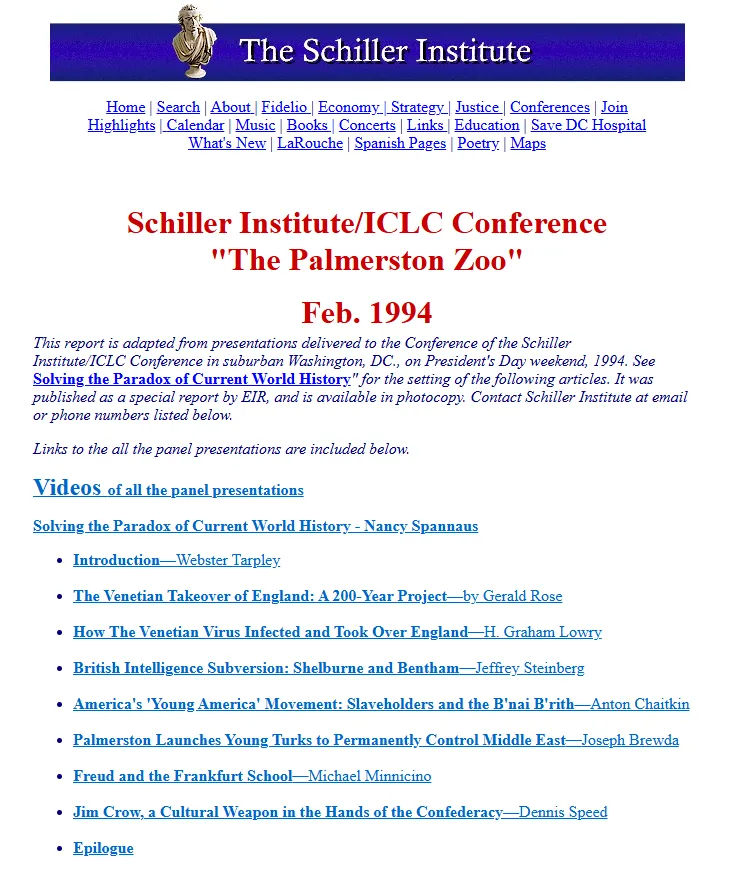
These sources document a 1994 Schiller Institute conference titled "Lord Palmerston's Multicultural Human Zoo," which presents a revisionist analysis of British imperial strategy during the nineteenth century. The materials argue that Lord Palmerston and the British oligarchy functioned as a "Venetian Party," using a method of strategic intelligence to manipulate global events through a network of sub-agents. Key presentations describe how Giuseppe Mazzini, Napoleon III, and David Urquhart acted as "stooges" to destabilize rival nations by inciting ethnic chauvinism and revolutionary terror. The text asserts that this geopolitical method was designed to establish a universal Roman Empire centered in London by suppressing human creativity and industrial development. Furthermore, the authors trace the philosophical roots of this system back to Venetian Aristotelianism and its eventual migration into the British political and economic establishment. Combined, these transcripts aim to provide an integrated understanding of history by exposing the underlying axioms that allegedly govern modern international conflicts.
Lord Palmerston's Zoo: Solving the Paradox of Current History President's Day 1994
Videos
Part(s) 1 - 3 How British Oligarchs Conquered the World
Expand for Source Guide
Part(s) 1-3 Include
- I Introduction /w Webster Tarpley
- II Into Continued (Webster Tarpley)
- III The Venetian Takeover of England: A 200-Year Project—by Gerald Rose
Part(s) 4 - 6 The Venetian Takeover of the English Mind
Expand for Source Guide
Part(s) #4-6 Include
- IV How The Venetian Virus Infected and Took Over England—H. Graham Lowry
- V British Intelligence Subversion: Shelburne and Bentham—Jeffrey Steinberg
- VI America's 'Young America' movement: slaveholders and the B'nai B'rith—Anton Chaitkin
Part(s) 7 - 9
Expand for Source Guide
Part(s) 7-9 Include
- VII Palmerston Launches Young Turks to Permanently Control Middle East—Joseph Brewda
- VIII Freud and the Frankfurt School—Michael Minnicino
- IX Jim Crow, a Cultural Weapon in the Hands of the Confederacy—Dennis Speed
Spotify Playlist
Lecture Notes (Compiled)
The Venetian Virus: From the Rialto to the British Empire
1. Introduction: The Paradox of History and the Power of Ideas
To master the art of strategic intelligence, the student must first discard the "many"—the incoherent jumble of dates, names, and battlefields that comprise standard historiography. We must instead solve the Parmenides Paradox: the relationship between the "One" and the "Many." As Plato demonstrated, the causal reality of any historical period lies not within the events themselves, but in the underlying axioms that bound them.
The "One" we are isolating is the Venetian Virus. This is not a biological pathogen, but a persistent cultural infection—a set of anti-human axioms designed to stifle human creativity and enforce oligarchical rule. When we look at the shifts from the 16th to the 19th centuries, we are observing a single, continuous method of control. To understand why the British Empire dominates the world today, we must look past its ships to its "causal reality": the Venetian method of destroying the human mind's ability to perceive universal truths.
The British Empire was never primarily an empire of geographical conquest; it was, and remains, an empire of the senses. By promoting empiricism—the doctrine that knowledge is limited to sensory perception—the oligarchy "bestializes" the subject. If a man believes he is merely a clever animal, he can be managed like livestock. This is the ultimate "Empire of the Mind," where mental chains are far more effective than physical ones.
We must now trace the "One" back to its source: the desperate lagoons of Venice and its existential war against the Renaissance.
2. The Venetian Root: The War on the Renaissance
Modern history begins with a collision of two irreconcilable ideas. The Italian High Renaissance, spearheaded by Nicolaus of Cusa, defined man as imago Dei (the image of God), endowed with a divine spark of creativity. The Venetian oligarchy, whose wealth was built on usury and the slave trade, recognized that a population of creative individuals is ungovernable.
| Feature | The Renaissance View of Man | The Aristotelian/Venetian View |
|---|---|---|
| Ontology | Imago Dei / Man as a creative, divine spark. | "Man as a beast" / A clever, sensory animal. |
| Social Aim | Justice and the common good (General Welfare). | Maintenance of fixed inequality and master-slave status. |
| Epistemology | Knowledge via hypothesis and universal ideas. | Knowledge limited to sensory perception (Empiricism). |
| Economic Basis | Technological progress and infrastructure. | Usury, looting, and human trafficking. |
The catalyst for the "Venetian Virus" was the War of the League of Cambrai (1509). When the powers of Europe briefly united to crush the Venetian "Republic of Usury," the oligarchy realized their island home was vulnerable. They survived through treachery, but the experience triggered a strategic metastasis. Meeting in the Ridotto Morosini, the "Youngsters" (Giovani) planned the relocation of their family fortunes (fondi) and their anti-human epistemology to a more defensible maritime base: the North Atlantic.
3. Phase I: The Tudor Infection and the "Sex Advisers"
The first phase of the Venetian cancer’s relocation targeted the English court. The goal was to break England’s alliance with Spain and the Church, effectively creating a northern fortress for Venetian interests.
The "causal agent" in this takeover was King Henry VIII's raging libido. The Venetians deployed Francesco Zorzi, a Cabbalist and "sex adviser," who provided the theological pretext for Henry’s divorce from Catherine of Aragon by claiming the Pope lacked authority over the marriage. Zorzi remained at court for life, building the nucleus of the "Venetian Party" in England.
Henry was managed by Thomas Cromwell, a ruthless technocrat who had served as an accountant for the Venetian-controlled Spirituali under Reginald Pole (a Plantagenet with a claim to the throne). While Pole initially advised the Tudors, Cromwell’s Venetian-trained efficiency ensured the total break with Rome, opening England to a "virus" carried by a specific set of aristocratic bloodlines:
- The Howards: The primary carriers who provided the "sexual bait" (Anne Boleyn) to snare Henry.
- The Russells, Cecils, and Cavendishes: Families that became the permanent vessels for the Venetian virus, later establishing the "little Padua" at Cambridge to train the oligarchy's next generation.
4. Phase II: Paolo Sarpi and the Invention of Empiricism
By 1600, the "metastasis" entered its most radical phase under Paolo Sarpi. A nominally Catholic monk but actually a radical atheist, Sarpi was the strategic gamemaster who realized that to destroy Christianity, one must destroy the human mind’s capacity to know God.
Sarpi created the myth that the "Pope is the Anti-Christ" to fuel the fires of the Thirty Years' War, while simultaneously training Francis Bacon in the "scientific method" of empiricism. This method insists that man can only know what he sees, touches, and smells. By denying the existence of universal ideas, Sarpi "bestialized" human reason.
Sarpi’s Three Fronts of Cultural Warfare:
- The Merchant Battering Ram: Establishing the Levant Company and East India Company (1600) to create a Venetian-controlled class of merchant-oligarchs.
- The Enlightenment Shell Game: Promoting radical nominalism to replace Renaissance science with sensory-based "Modernism."
- The Syncretic Cults: Launching the Rosicrucian and Freemasonic networks as an inner sanctum for the elite. This included the use of "false messiahs" like Sabbatai Zevi, whose movement was supported by English Puritan merchants to destabilize rival powers.
5. The "Glorious Revolution" and the Birth of "New Rome"
The takeover was finalized in the 1688 "Glorious Revolution." The oligarchy invited William of Orange to seize the throne, formally establishing what Benjamin Disraeli called the "Venetian Constitution." Under this system, the King was reduced to a "Doge"—a figurehead—while the true power resided in a Senate of Whig Magnificoes.
In 1694, the oligarchy established the Bank of England. This was not a financial institution but a gargantuan Venetian swindle. By creating national debt to finance perpetual wars of attrition, the Bank allowed the oligarchy to loot the nation’s tax revenue. To manage the "swindle," the Venetian Party deployed Isaac Newton, who oversaw the "recoinage" of the currency while prostituting his own niece to the Chancellor of the Exchequer, Charles Montagu.
The Global Pivot (1702–1763)
| Event | Date | Strategic Result |
|---|---|---|
| Peace of Utrecht | 1713 | Britain wins the asiento—the monopoly on the global slave trade—forming the foundation of British wealth. |
| South Sea Bubble | 1720 | A massive blowout of financial speculation, used to consolidate power under Prime Minister Robert Walpole. |
| Seven Years' War | 1756-63 | France is destroyed as a naval rival; the British Empire emerges as the mistress of the seas and the paramount power in India. |
6. The Resistance: Leibniz vs. The Hell-Fire Clubs
The Venetian takeover did not go unchallenged. A "Humanist Resistance" led by Gottfried Wilhelm Leibniz fought to save England. Leibniz defined the "Science of Happiness" as universal benevolence—the habit of regarding another’s happiness as one’s own, rooted in the idea of man as imago Dei.
Leibniz’s allies, including Jonathan Swift and later Benjamin Franklin, fought against the "bestialization" of the mind promoted by John Locke. Locke argued the mind was a tabula rasa (blank slate) capable only of registering animal sensations. To Locke, "liberty" was merely the hedonistic pursuit of property.
While the resistance fought for the "Science of Happiness," the British elite retreated into the Hell-Fire Clubs. These were the inner sanctums of the degenerate elite, where the cabinet of the King practiced mock-Satanic rituals. Their depravity was captured in their dining menus, which featured items like "Holy Ghost Pie," "Devil's Loins," and "Breast of Venus" (garnished with cherries for nipples). This was the cultural reality of the new "Roman Empire."
7. Central Metaphor: Lord Palmerston’s Multicultural Human Zoo
By 1850, under Lord Palmerston, the Empire reached its peak efficiency. Palmerston understood that the British army was third-rate and the fleet was vulnerable. The true force of empire was the control of culture.
He managed the world as a Multicultural Human Zoo. In this zoo, different ethnic groups were kept in "theme parks" of aggressive, racial chauvinism. Palmerston’s strategy of "National Liberation" was actually a tool for universal ethnic cleansing, designed to break up rival empires (Austria, Russia, Ottoman) into warring, manageable pawns.
To prevent any group from uniting against the Empire, the British "Zookeepers" promoted the belief that race is destiny. By keeping the "animals" focused on blood-and-soil hatreds, the oligarchy ensured that the "zoo" would never have to worry about a human revolt.
The "Three Stooges" of Palmerston’s Zoo:
- Giuseppe Mazzini: The "Zookeeper" of ethnic chauvinism. He assigned racial "missions": the British would take care of Industry, the Poles would lead the Slavic world, and the Russians would "civilize" Asia. He taught that there are no inalienable rights—only the "Duty" to the racial collective.
- David Urquhart: The handler of Karl Marx. Urquhart promoted "bucolic medieval myths" and convinced the working class that technological progress was an evil Russian plot, successfully retarding industrial development.
- Napoléon III: Palmerston’s "strategic catamite." An inflatable British agent used to provide a land army for British wars (like the Crimean War) and the prototype for the 20th-century fascist dictator.
This network was used to launch the American Civil War and the global conflagrations of the 20th century.
8. Conclusion: The Empire of the Senses
The British Empire is not a country; it is a method. It is the continuation of the Venetian Virus, a system that seeks to reduce humanity to a collection of beasts fighting over "blood and soil" in a managed zoo. Its power lies entirely in its ability to control how people think—to trap them within the limits of their five senses and their immediate pleasures and pains.
Intelligence-Oriented Student Action List:
- Isolate the Causal Axioms: Do not look at what a politician says; look at their view of man. Do they treat people as creative sparks or as sensory animals to be managed?
- Analyze the "Zoo" Dynamics: Watch for modern "NGOs" and movements that promote ethnic chauvinism or "blood and soil" identities. These are the modern iterations of Mazzini’s theme parks.
- Identify the Attack on Progress: Recognize that movements which mock scientific and technological advancement are often carrying the "Urquhart" strain of the virus, designed to return humanity to feudal simplicity.
- Reject Sense-Certainty: Recognize that the "information overload" of the senses is a distraction. Causal reality—the "One"—is found in universal principles, not the "Many" of the news cycle.
The oligarchy’s greatest weapon is the "price" it places on every man. They believe that every human soul can be bought with pleasure or cowed with pain. To defeat the empire, one must simply refuse to be an animal. We must not pay the price.