



Perturbation Theory & Introduction to Particle Interactions
Particle Interactions: A Conceptual Primer on Scattering and the Born Series
1. Beyond the "Little Ball": The Field-Theoretic Paradigm
To understand how matter interacts, we must first dismantle the Newtonian image of a particle as a discrete, "billiard ball" traveling through an empty container. In modern Quantum Field Theory (QFT), space is not an empty void; it is a dynamic, continuous medium consisting of various fields.
What we perceive as a "particle" is actually a quantized excitation of its underlying field—a localized disturbance often called a "wavicle." While experiments have failed to find any physical "size" for particles like the electron, leading us to call them "point-like," this does not mean they are zero-dimensional objects. Rather, in QFT, "point-like" refers to the fact that our Field Operators—the mathematical tools that create or destroy these excitations—act upon a single point in space-time.
| Attribute | Classical Point Particle | Quantum Field Excitation (Wavicle) |
|---|---|---|
| Spatial Extent | Zero-dimensional (0D) point | Spread over a region, peaked at the excitation |
| Interaction Mode | Direct contact or action-at-a-distance | Local interaction mediated by field operators |
| Occupancy | Mobile degrees of freedom in empty space | Field degrees of freedom exist at all points |
| Mathematical Basis | Ordinary Differential Equations (ODEs) | Field Operators / Partial Differential Equations |
Learning Narrative: Transitioning from "little balls" to "wavicles" changes our view of encounters. Instead of a mechanical impact, we must visualize how these field disturbances influence the vacuum and each other.
2. The Mechanics of the "Collision"
If particles are field disturbances, a "collision" is the result of overlapping field influences. However, there is a fundamental limit to viewing a particle as a single, isolated point. This limit is defined by the Compton Wavelength.
Consider a thought experiment: if you attempt to confine an electron in a box smaller than its Compton wavelength, the "point-like" illusion shatters. You do not end up with a smaller, more localized electron. Instead, because the energy required for such confinement is so high, the vacuum itself reacts. The field’s multi-particle nature is revealed as the energy "boils" the vacuum, producing particle-antiparticle pairs.
At this scale, a "collision" is not a simple bounce but a complex exchange where the identity of the "single" particle is lost in a sea of field fluctuations.
Learning Narrative: Because the math describing these overlapping fields is incredibly complex, physicists use Perturbation Theory to approximate the chaos of a collision, treating it as a series of distinct, manageable events.
3. The Born Series: A Narrative of "Interruptions"
The Born Series, derived from the Lippman-Schwinger equation, allows us to visualize interactions as a story of "interruptions." It assumes that a particle’s total state is the sum of its "free" (unperturbed) movement and a series of corrections caused by an interaction potential.
Mathematically, these interruptions are linked by the Free Green’s Function (or Propagator), which acts as the "bridge" of free propagation between events. We categorize the interaction by "orders":
- 0th Order (The Unperturbed Path): The particle reaches the detector without ever "feeling" the potential. It is a straight, unscattered flight.
- 1st Order (Single Scattering): The particle propagates freely, undergoes exactly one scattering event at a specific point r', and then continues freely to the detector.
- 2nd Order (Double Scattering): The particle is interrupted twice, scattering at point r' and then at r'' before reaching the detector.
- n-th Order (Multiple Scattering): The particle undergoes a complex series of n collisions, representing an intricate path through the interaction zone.
Synthesis: The total scattering amplitude—the probability of a specific outcome—is the sum of all these possible paths. This iterative logic suggests that the reality of an interaction is the sum of every possible way a particle could have been "interrupted."
Learning Narrative: While the Born Series is a rigorous mathematical expansion, its complexity quickly becomes overwhelming. To make these "interruptions" visible, we use a specialized visual language.
4. Feynman Diagrams: The Language of Interaction
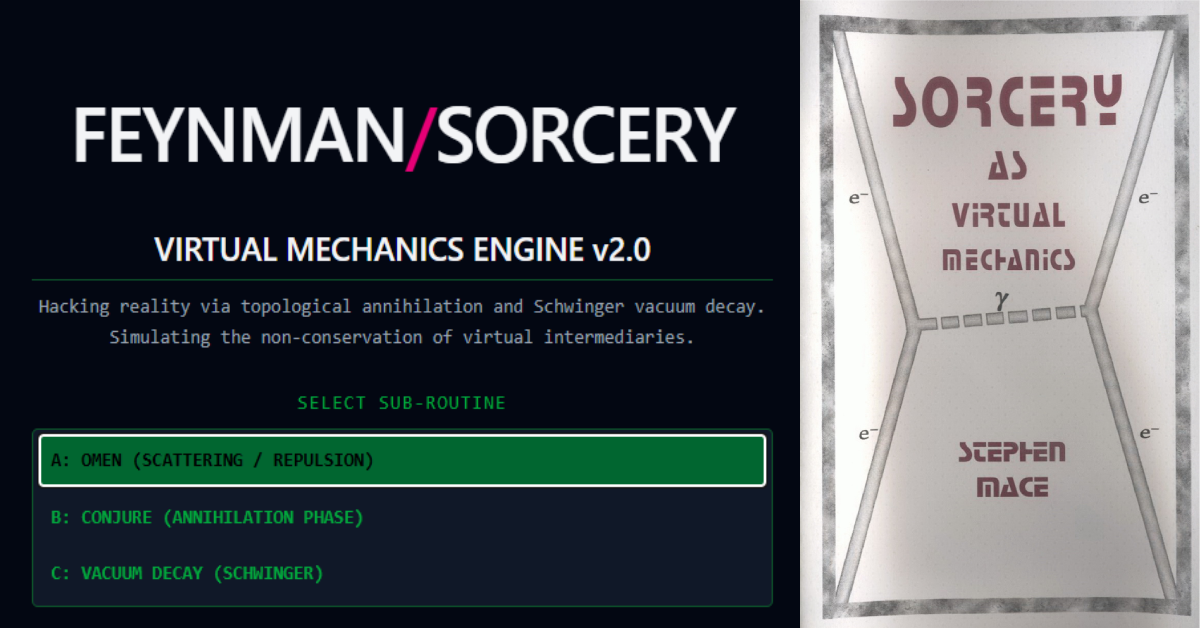
View the Simulation Here: https://virtual-dynamics.vercel.app/
++ THE OMEN ENGINE ++
Because neither entity yields, a virtual photon forces a trajectory correction via spontaneous synchronization (an omen).

Feynman Diagrams are not mere cartoons; they are a rigorous, formal language for mapping the S-matrix (the Scattering Matrix). They serve as a visual shorthand for the Dyson Series and Wick’s Theorem, allowing us to calculate the probability of transitions between initial and final states by tracking how field operators interact.
Every diagram is composed of three essential elements:
- External Lines: Represent real particles entering or leaving the interaction. These are the "asymptotic states" we actually measure in a lab.
- Vertices: Points where lines meet, representing the interaction Hamiltonian in action. This is where the "collision" or transformation actually occurs.
- Internal Lines: These represent Propagators or virtual particles. They are the mathematical "shimmering" of the Born Series made visible, linking vertices but never reaching a detector.
Learning Narrative: The "internal lines" are the most mysterious part of the language, representing entities that exist "off-shell," momentarily defying the standard laws of mass and energy.
5. The Virtual Realm: On-Shell vs. Off-Shell Dynamics
In physics, the Mass-Shell Relation defines the boundary of classical reality. It is a mathematical hyperboloid in energy-momentum space dictated by the equation:
- On-Shell (Real Particles): These satisfy the equation. They are stable, detectable, and follow the standard relationship between mass, energy, and momentum.
- Off-Shell (Virtual Particles): These exist only within the interaction. They "borrow" energy from the vacuum via the Heisenberg Uncertainty Principle. Because they are off-shell, they are qualitatively different; for example, a virtual photon can possess longitudinal and scalar polarization and effective "mass," whereas a real photon is strictly massless with only two polarization states.
| Attribute | On-Shell (Real) | Off-Shell (Virtual) |
|---|---|---|
| Detectability | Directly detectable as asymptotic states | Undetectable; only appear in calculations |
| Equations of Motion | Strictly follows | Deviates from standard mass-energy relations |
| Polarization/States | Standard (e.g., 2 for photons) | Extra states (e.g., longitudinal/scalar) |
| Lifespan | Can be stable and long-lived | Transitory; limited by Uncertainty |
Learning Narrative: The distinction between on-shell and off-shell defines our current understanding of existence—where force-mediating "virtual" states are the hidden machinery behind the "real" matter we see.
6. Synthesis: "It from Bit" and the Informational Perspective
When we synthesize scattering theory with the "Informational-Structure" perspective, we see a universe built not of objects, but of distinctions. Following John Wheeler’s "It from Bit" philosophy and the work of Stan Tenen, we can view the very beginning of an interaction as the "First Distinction."
In Tenen's analysis, the Hebrew letter Bet (meaning "house") represents the fundamental act of distinguishing "inside" from "outside." This is the ultimate informational "Bit." Without this first distinction, no field, no excitation, and no interaction can exist. Scattering is the process by which these informational nodes (particles) interact to preserve or change their phase identity.
The 3 Most Important Insights
- Particles are Stable Nodes: A particle is not a "thing" but a stable node in an informational field—a localized phase relation within a larger network of field coherence.
- Existence is Identity Preservation: To "exist" means that a relational field preserves its phase identity through an interaction. Dimensionality is not an intrinsic size but an emergent property of how these nodes correlate.
- The Vacuum is a Potential Sea: The "nothingness" of the vacuum is a dynamic sea of potential where field fluctuations constantly create and destroy virtual entities, maintaining the structural integrity of the laws of physics.
Closing Statement: Ultimately, scattering theory teaches us that the boundary between "virtuality" and "reality" is fluid. Our universe is defined by the constant, shimmering interaction of fields, where the act of collision—the "First Distinction"—is the very mechanism through which the structure of existence is revealed.
Foundational Overview: From Points to Fields—The Geometry of Reality
1. The Cognitive Challenge: Why We Struggle with the Very Small
As we descend from the macroscopic world into the subatomic realm, our primary obstacle is not merely technical, but cognitive. Human intuition is a byproduct of evolutionary pressures that favored the navigation of three-dimensional, medium-sized objects. Consequently, we are predisposed to a specific "Common Sense" error when evaluating the building blocks of reality.
The Cognitive Bias of Scale This is the intuitive, yet scientifically unsupported, belief that for an entity to possess "existence," it must occupy a physical volume or have a three-dimensional spatial extent. We intuitively equate "being" with "occupying a box of space."
Consider a strand of human hair or a sheet of paper. If we were to mathematically "shrink" their thickness toward zero, our intuition suggests they would simply vanish into non-existence. This is the hurdle: we struggle to accept that a zero-dimensional (0D) point or a one-dimensional (1D) string can be "real." We demand a "zebra" where the universe often provides a "line." To advance our curriculum, we must move past these sensory expectations and recognize that dimensionality is not a prerequisite for existence, but a characteristic of interaction.
2. The Zero-Dimensional Point (0D): The Standard Model’s Map
In the Standard Model, we operationally define fundamental particles like electrons as "point-like." This is a map, not the territory. It signifies that our field operators—the mathematical tools of Quantum Field Theory (QFT)—depend on a single point in space-time.
| Attribute | Idealized Classical Point (Newtonian) | Quantum Field Excitation (Wavicle) |
|---|---|---|
| Spatial Extent | Zero-dimensional (0D) literal point. | Spread over a region, peaked at the excitation. |
| Position Definition | Well-defined position vector x_a(t). | Not conceptually sharp; subject to field dynamics. |
| Interaction Mode | Direct contact or action-at-a-distance. | Local interaction via overlapping field disturbances. |
| Mathematical Basis | Ordinary Differential Equations (ODEs). | Partial Differential Equations (PDEs) / Operators. |
The primary benefit of this 0D description is its mathematical elegance and operational success; to date, no experiment has successfully measured a "radius" for the electron. However, the 0D model reaches a hard limit at the Compton wavelength. If we attempt to confine an electron to a region smaller than this length, the system ceases to behave as a single particle. Instead, the energy required for confinement triggers the vacuum to produce particle-antiparticle pairs. In the Fock basis, our "single point" dissolves into a multi-particle state, revealing the underlying field nature of reality.
3. The One-Dimensional String (1D): Introducing Extent
String Theory serves as a conceptual alternative to the 0D model, proposing that the fundamental constituents of reality are 1D strings. This shift is motivated by the need to resolve the mathematical divergences of point-particles and to address our lingering intuition that existence requires extent.
3 Reasons for Strings:
- Internal Structure: By replacing a point with a string, we gain vibrational degrees of freedom. Different "notes" on the string correspond to the different masses and charges we observe in particles.
- Addressing the "Existence" Intuition: It provides a finite, non-zero spatial extent, satisfying the conceptual argument that fundamental blocks should be "physically there" in more than zero dimensions.
- Mathematical Convergence: Strings "smear out" interactions, preventing the infinite energy densities that plague point-particle models when gravity is introduced, offering a path toward Quantum Gravity.
Despite this beauty, String Theory faces a rigorous critique: it has yet to produce a testable prediction that distinguishes a "string" from a "point" or a "tiny zebra." Furthermore, matching the theory to the specific, observed properties of our unique universe remains an elusive challenge, leaving the 1D model as a powerful framework awaiting empirical validation. As we move from discrete objects like points and strings, we find the most robust description of reality lies in a continuous, universal medium.
4. The Universal Field: The "Ocean" of Reality
We must now pivot from the "particle in a void" perspective to the "field-theoretic" paradigm. In this view, space is not an empty container but a continuous medium. What we previously called particles are actually Wavicles: quantized excitations of an underlying field.
- The Vacuum State: The ground state of the field; not "nothing," but a sea of fluctuating energy and potential.
- Field Operators: Mathematical tools that "disturb" the vacuum to create a localized peak of energy.
- Wavicles: Emergent phenomena where the field's degrees of freedom manifest as a stable, quantized excitation.
To visualize this, imagine the ocean. We might give unique names to a "whitecap" or a "swell," but they are merely different fluctuations of the same water. Similarly, electrons, quarks, and gluons are simply the labels we give to different disturbances in their respective fields. Interactions occur not through the "collision" of solid dots, but through the overlapping of these disturbances.
5. On-Shell vs. Off-Shell: Defining "Real" Existence
In the dynamics of these fields, we distinguish between "real" and "virtual" states using the Mass-Shell Relation:
| Feature | On-Shell (Real) Particles | Off-Shell (Virtual) Particles |
|---|---|---|
| Detectability | Directly detectable; leave tracks in detectors. | Indirectly inferred; cannot be isolated. |
| Mathematical Status | External lines in Feynman diagrams. | Internal lines (propagators) in Feynman diagrams. |
| Conservation | Strictly obeys the Mass-Shell relation. | "Off-shell"; do not follow standard mass-energy relations. |
| Polarization | Real photons have 2 transverse states. | Virtual photons can carry longitudinal and scalar states. |
Virtual particles are "mathematical ghosts" permitted by the Heisenberg Uncertainty Principle, allowing the vacuum to "borrow" energy for fleeting durations. They are essential mediators of force; for instance, the static electromagnetic attraction between two charges is maintained by the exchange of virtual photons carrying longitudinal and scalar polarization modes that real, massless photons do not possess. This brings us to a deep philosophical crossroad regarding what we consider "real."
6. Philosophical Perspectives: Reality vs. Math
Because our most successful theories rely on these unobservable entities, we must choose an ontological stance:
- Scientific Realism: The "No-Miracles" argument. It posits that the extreme predictive accuracy of the Standard Model would be a miracle if the entities it describes—like virtual particles—did not actually exist.
- Instrumentalism: Views particles as "mathematical artifacts." They are useful bookkeeping devices for the Dyson series, but we should not assume they are physical objects.
- Structural Realism: Argues that the "stuff" (particles) is secondary to the relational structures. The reality is found in the symmetries, such as SU(3), rather than the things being rotated.
- Constructive Empiricism: Focuses on "empirical adequacy." If the math matches the observation, the theory is "true" enough; we remain agnostic about the underlying unobservable "ghosts."
7. The Information Synthesis: "It from Bit"
The ultimate resolution of the conflict between 0D points, 1D strings, and continuous fields lies in the Informational-Structure (IS) perspective. In this view, we move from "things" to "information." As John Wheeler famously suggested, "It from Bit"—the physical world emerges from fundamental informational distinctions.
Stan Tenen’s work on the "First Distinction" provides a geometric anchor for this. He demonstrates that the Hebrew letter Bet (
Summary of Synthesis:
- Effective Projections: 0D points and 1D strings are not "things" but effective projections of informational nodes. A "point" is a stable node in an informational field where the relational structure preserves its identity through interaction.
- Emergent Dimensionality: Dimensionality is not a container, but a correlation between these informational nodes. At the scales of the Standard Model, treating these nodes as 0D points is the most efficient informational description.
- Log-Periodic Phases: Reality is information oscillating across scales. The transition from point-like to field-like (as seen at the Compton wavelength) is a shift in the phase relation within a larger coherence network.
The vacuum, therefore, is a sea of potential—a dynamic medium where "existence" is defined as a relational field preserving its phase identity. Whether we observe a point, a string, or a wave depends entirely on the scale and the informational projection we employ to map the underlying "Bit."
Ontological Evaluation: The Metaphysical Status of Virtual Entities in QFT
1. From Newtonian Points to Quantum Wavicles: The Shift in Physical Ontology
The transition from classical mechanics to Quantum Field Theory (QFT) represents a seismic shift in our fundamental understanding of the constituents of reality. In the seventeenth-century Newtonian paradigm, the "particle" was a discrete, localized point—a zero-dimensional object roaming through an otherwise empty spatial container. Modern QFT, however, necessitates a fundamental redefinition: particles are no longer primary building blocks but emergent phenomena. They are localized excitations of underlying fields that permeate the entirety of space-time. This strategic move from the "point" to the "wavicle" (a quantized field excitation) suggests that what we perceive as matter is actually a dynamic disturbance within a continuous medium, governed not by the ordinary differential equations (ODEs) of position vectors, but by the complex partial differential equations (PDEs) of field dynamics.
The following table summarizes the shift in how physical entities are modeled across competing theoretical frameworks:
| Attribute | Classical Point Particle | Quantum Field Excitation | String Theory Framework |
|---|---|---|---|
| Spatial Extent | Zero-dimensional (0D) point. | Spread over a region, peaked at excitation. | One-dimensional (1D) extended string. |
| Interaction Mode | Action-at-a-distance or direct contact. | Local interaction mediated by gauge bosons. | Vibrational modes of extended entities. |
| Mathematical Basis | Ordinary Differential Equations (ODEs). | Partial Differential Equations (PDEs) / Operators. | Strings as fundamental 1D objects. |
The Limits of Zero-Dimensionality The characterization of particles as "point-like" in the Standard Model is frequently an operational convenience rather than a literal ontological claim. A primary limitation of the zero-dimensional intuition is found in the Compton wavelength. An entity like an electron cannot be confined to a spatial region smaller than its Compton wavelength without losing its identity as a single particle; at such scales, the field nature dominates, and the vacuum begins producing particle-antiparticle pairs. This necessitates a transition to the multi-particle state in the Fock basis, undermining the classical intuition of a singular, zero-dimensional object. "Particles," therefore, are merely stable nodes in a complex field-theoretic network. This shift from localized points to field disturbances sets the stage for the mathematical approximations required to calculate their interactions.
2. The Perturbative Framework: Dyson Series and the Born Approximation
In interacting systems where the complexity of the field dynamics makes exact solutions impossible, perturbation theory serves as the "working framework" of the Standard Model. This method treats complex interactions as small corrections to a simpler, non-interacting "free" system. By approximating the behavior of the system through successive layers of complexity, physicists can calculate scattering amplitudes and decay rates with extraordinary precision.
Mechanics of the Born Series The scattering problem is formally addressed via the Lippman-Schwinger equation, which relates the full interacting state to the unperturbed state. The Born series is the iterative expansion of this equation, providing a physical interpretation of an interaction as a sequence of free propagations punctuated by instantaneous "collisions."
- 0th Order: The particle reaches a detector without any scattering or interaction.
- 1st Order: A single scattering event occurs at a specific point in space-time, followed by free propagation.
- 2nd Order: A double scattering event, involving two distinct points of interaction (potential vertices).
- nth Order: Multiple scattering events representing highly complex interaction paths summed over the S-matrix.
The "Shimmering" of Virtualities We must critique the status of the Born series: is it a depiction of reality or a mere calculation tool? The "shimmering" of virtual particles emerges from the algebraic application of Wick's theorem, which rewrites time-ordered products of field operators as a sum of normal-ordered terms and contractions. While these mathematical tools provide incredible predictive accuracy, Instrumentalists often dismiss them as artifacts of the algebraic method. However, these mathematical "collisions" are the very mechanisms that force a field "off-shell," forcing us to reconcile theoretical mediation with physical constraints.
3. The Mass-Shell Dichotomy: On-Shell Reality vs. Off-Shell Virtualization
The boundary between detectable reality and theoretical mediation is defined by the mass-shell relation:
- On-Shell States: "Real" particles that satisfy the mass-energy equivalence formula. They are stable enough to be detected as asymptotic states. For instance, a real photon is massless and possesses only two transverse polarization states.
- Off-Shell States: "Virtual" entities that do not satisfy the standard mass-energy relation. A virtual photon, as a force mediator, can effectively possess mass and carry longitudinal or scalar polarizations that are strictly forbidden for its "on-shell" counterpart.
The temporary existence of off-shell virtual entities is permitted by the Heisenberg Uncertainty Principle (
The Propagator as an Ontological Boundary The "Propagator" represents the virtual particle in mathematical terms. It typically contains singularities exactly on the mass shell, suggesting that the "virtuality" of an entity is proportional to its distance from this boundary. As an intermediate particle moves further off-shell, the amplitude for the process diminishes. The mathematical singularity at the mass-shell creates an epistemological void; the unobservable nature of the propagator's internal lines necessitates a shift to a philosophical dialectic, as the mathematics alone cannot "see" the interior of the interaction region.
4. Philosophical Dialectic: Realism, Instrumentalism, and the "No-Miracles" Argument
The status of virtual particles—whether they are real components of the universe or mathematical bookkeeping devices—remains the central conflict in theoretical ontology.
| Position | View on Virtual Particles | Primary Argument |
|---|---|---|
| Scientific Realism | Real entities existing in the world. | The "No-Miracles" argument: the predictive success of QED (e.g., the electron's magnetic moment) would be a miracle if these entities were not real. |
| Instrumentalism | Mathematical tools / "Mere fictions." | Artifacts of the Dyson series; they are unobservable in isolation and thus ontologically null. |
| Constructive Empiricism | Agnostic regarding unobservables. | Science only needs "empirical adequacy." The truth of virtuality is irrelevant to the utility of the theory. |
Adjudicating the Instrumentalist Deficit The Instrumentalist view—that virtual particles are "mere fictions"—is ontologically impoverished and fails to account for sophisticated light-matter interactions. Consider the "Dressed Photon" in nanoscale effects, where energy localization defies conventional optical theory, or the "Resolved Photon" behavior. In high-energy contexts, the photon fluctuates into fermion-antifermion pairs, behaving as a hadron. This "Vector Meson Dominance" (VMD) model demonstrates that virtual entities possess complex, hadron-like internal structures. These are not mere "ghosts" in the math; they are physical dynamics with measurable consequences.
5. The Informational Turn: Structural Realism and the "First Distinction"
A modern synthesis in theoretical ontology moves away from "things" and toward "structure," epitomized by the "It from Bit" perspective. Here, dimensionality and particles emerge from a fundamental relational field.
The First Distinction and Geometric Structure The logical precursor to matter is the "First Distinction." Drawing from G. Spencer-Brown’s Laws of Form, we identify the "First Distinction"—archetypally represented by the Hebrew letter Bet (meaning "house" or "separation")—as the act of severance that creates space. Stan Tenen’s research suggests this is not merely an abstract concept but is rooted in the "First Hand" model—a 3,10 torus knot whose geometric projections generate the alphabetic forms. This torus knot represents the fundamental vortex of information from which all distinctions arise.
Ontic Structural Realism (OSR) OSR argues that structure is ontologically prior to objects. In this view, particles are not "furniture" but equivalence classes under symmetry transformations, such as the SU(3) group of the strong interaction. This resolves the point vs. string conflict:
- Point Particles: Projections of informational nodes behaving as if they were point sources.
- Strings: Explicit internal structures introduced to explain the same field coherence.
Existence, therefore, is defined by whether a relational field preserves its phase identity through an interaction. This informational-structure perspective dissolves the dimensionality bias: existence is the preservation of phase identity across scales.
6. Conclusion: The Ontological Verdict on Virtual Entities
The investigation into perturbative quantum mechanics leads to a definitive shift in the categorization of "existence." While virtual particles lack the independent, on-shell stability of "real" particles, their role in force mediation and the predictive success of the Standard Model—specifically through VMD and resolved photon models—cannot be dismissed.
Final Postulates:
- Status as Excitations: Virtual particles are legitimate, albeit fleeting, off-shell field excitations permitted by the energy-momentum fluctuations of the vacuum.
- Structural Relata: They function as structural relata—essential interaction nodes—rather than independent objects. Their reality resides in the mathematical and symmetry relations (such as SU(3)) they sustain.
- Informational Necessity: In the "It from Bit" paradigm, virtual entities represent the necessary informational transitions—the "logic of the field"—required for the emergence of stable matter.
Verdict: Virtual particles may be "mathematical ghosts" by classical Newtonian standards, but within a rigorous quantum ontology, they are essential, stable nodes in the informational field. They represent the preservation of phase identity that constitutes the very fabric of reality.
Theoretical Framework Assessment: The Transition from Newtonian Point-Mechanics to Relativistic Quantum Field Theory
1. Introduction: The Paradigmatic Shift in Physical Reality
The evolution of theoretical physics from the seventeenth-century Newtonian framework to contemporary Relativistic Quantum Field Theory (QFT) represents a fundamental reconstruction of our understanding of existence. Newton’s 1687 Principia established a reality of localized, discrete point particles tracking position vectors
Crucially, the preservation of Poincaré invariance—the requirement that physical laws remain consistent across all relativistic frames—demands the field-theoretic approach. Within special relativity, charged point particles cannot interact directly or instantaneously without violating causality; interactions must be mediated by a continuous field to preserve the finite speed of information. In this modern context, the "particle" is no longer a fundamental unit but an emergent phenomenon: a quantized excitation of an underlying field, frequently termed a "wavicle."
The transition between these paradigms is summarized by the shift in their fundamental degrees of freedom:
- The Newtonian Paradigm: Reality is composed of mobile point-positions roaming through a space that functions as a passive, empty container. Dynamics are governed by ordinary differential equations (ODEs).
- The Field-Theoretic Paradigm: Reality consists of field properties at every point in space-time. Space is a dynamic medium where field degrees of freedom are ever-present. Dynamics are governed by field operators acting upon a vacuum ground state and partial differential equations (PDEs).
2. Comparative Analysis of Spatial Extent and Position
A primary hurdle in transitioning to QFT is the cognitive bias requiring physical extent—a "size"—for an entity to be considered "real." At the subatomic level, this intuition fails. While human macroscopic experience suggests existence requires volume, QFT demonstrates that existence is defined by localized disturbances in a field rather than intrinsic spatial volume.
Structural Differentiators: Classical Points vs. Quantum Field Excitations
| Attribute | Classical Point Particle | Quantum Field Excitation (Wavicle) |
|---|---|---|
| Spatial Extent | Zero-dimensional (0D) point. | Spread over a region; peaked at the site of excitation. |
| Position Definition | Sharp, well-defined coordinates | Not conceptually sharp; subject to field dynamics and uncertainty. |
| Mathematical Basis | Ordinary Differential Equations (ODEs). | Field Operators acting upon a Vacuum Ground State. |
| Occupancy | Localized degrees of freedom in empty space. | Field degrees of freedom exist at all points in space-time. |
Evaluating the "Point-Like" Misinterpretation
The Standard Model’s use of "point" notation refers to the fact that field operators depend on a single point of space-time, yet the physical reality is a "spread out" field excitation. The limits of the point-particle model are starkly characterized at the scale of the Compton wavelength. An electron cannot be confined to a region smaller than its Compton wavelength without the field nature becoming dominant; at this scale, the vacuum begins producing particle-antiparticle pairs. This marks the failure of the single-particle description and the necessary transition to the Fock basis, where the state is defined by a variable number of particles.
The "So What?" Layer: The spread-out nature of field excitations resolves the classical "pointon" problem. In a purely classical point-particle model, zero-dimensional particles following geodesics in space-time would generically fail to meet, rendering interactions statistically impossible. By modeling particles as field disturbances that naturally overlap, QFT ensures that interactions are a localized result of field dynamics rather than accidental collisions of 0D points.
3. Interaction Modes and the Dynamics of Scattering
QFT replaces classical action-at-a-distance with local interactions mediated by gauge bosons. We investigate these through Scattering Theory, observing how field excitations interact to reveal underlying field properties. The central object is the S-matrix, mapping probability amplitudes from initial to final free states via the Lippman-Schwinger equation and the free Green's function (propagator). Iterative solutions to this equation generate the Born Series.
The Born Series: Orders of Interaction
| Order of Born Series | Physical Interpretation |
|---|---|
| 0th Order | The particle reaches the detector without any interaction/scattering. |
| 1st Order | A single scattering event occurs at a specific point, followed by free propagation. |
| 2nd Order | A double scattering event occurs at two distinct points. |
| Multiple scattering events representing complex, high-order interaction paths. |
The Conceptual Shift: The Born series depicts interactions not as smooth motion, but as "free propagation punctuated by instantaneous collisions." If we view interactions merely as a summation of terms from 0 to n, the "path" of a particle begins to look like a mathematical construct rather than a literal trajectory. This supports the instrumentalist view: that our perturbative descriptions are bookkeeping devices for field fluctuations, not necessarily literal representations of a single particle's journey.
4. Virtual Mechanics and the Off-Shell Domain
The boundary between classical and quantum reality is defined by the Mass-Shell relation:
Configurations satisfying this are On-Shell; these are the detectable asymptotic states. However, the internal mechanics of field interactions rely on Off-Shell states—virtual particles.
Virtual Particles as Mediators
Virtual particles are force mediators that exist only during the interaction. Unlike their "real" counterparts, they are not restricted by standard mass-shell constraints. A real photon is strictly massless with two polarization states. In contrast, a virtual photon is transient and "unreal," effectively possessing mass and three polarization states (longitudinal, scalar, and transverse).
Reciprocal Energy Trade-offs
The existence of these entities is permitted by the Heisenberg Uncertainty Principle, which establishes a reciprocal trade-off: the further off-shell a configuration is (the more energy is "borrowed" from the vacuum), the shorter its lifespan. These "mathematical ghosts" allow for high-precision calculations of forces, yet their unobservable nature prompts profound questions regarding what is "real" versus what is a "mathematical artifact."
5. The Ontological Status of Physical Entities
The reliance on unobservable virtual entities has split the scientific community between realism, instrumentalism, and structuralism.
| Position | View on Virtual Particles | Key Argument |
|---|---|---|
| Scientific Realism | Real entities existing in the world. | No-Miracles Argument: The predictive success of QFT would be a miracle if these entities weren't real. |
| Instrumentalism | Mathematical tools or artifacts. | Non-perturbative methods like Lattice Gauge Theory do not require virtual particles, suggesting they are artifacts of perturbation theory. |
| Structural Realism | Manifestations of relational structure. | Mathematical relations and structures persist even when specific entity descriptions change. |
| Constructive Empiricism | Agnostic/Empirically adequate. | Science only needs to describe observable phenomena; truth regarding unobservables is irrelevant. |
Ontic Structural Realism (OSR): Physically, OSR argues that symmetries—such as SU(3) in the strong interaction—are the "fundamental furniture" of the world. In this view, particles are not individual "things" but merely members of equivalence classes under these transformation groups. The underlying mathematical structure is ontologically prior to the objects that manifest it.
6. Information as the Ground of Being: The "First Distinction"
Contemporary physics is increasingly gravitating toward the "IT from BIT" hypothesis, where physical entities derive from informational distinctions. This connects the mathematical foundations of QFT to the ontological concept of the "First Distinction."
Idealization vs. Idolatry As Stan Tenen argues, the historical move toward "mathematical points" was an act of abstract idealization—a strategic shunning of physical "idols" (fixed, material sizes) in favor of universal, universal relations. This mirrors the "Mark of Distinction" framework found in G. Spencer-Brown’s Laws of Form, where a universe arises only when a space is "taken apart" or severed.
The Gestural Alphabet In this framework, the Hebrew letter Bet (\beth), meaning "house," represents the First Distinction: the boundary between inside and outside. This is not merely a metaphor; it is the logic of distinction itself.
- Existence: Defined by whether a relational field preserves its phase identity through interaction.
- Dimensionality: Emerges from the correlations between informational nodes, rather than intrinsic size.
- The Alphabet of Reality: Geometry and gesture serve as the "alphabet" for modeling self-organizing physical systems. The "point" is not a 0D dot in a void, but a stable node in an informational field—a localized phase relation within a larger coherence network.
7. Synthesis and Final Assessment
Quantum Field Theory is the most accurately tested theory in history, succeeding precisely because it prioritizes the continuous field over the discrete particle. The transition from Newtonian point-mechanics to QFT requires a total shift in our ontological commitments, moving from "things" to "relations."
Critical Takeaways:
- Field Primacy: Fields are fundamental; particles are emergent, quantized excitations ("wavicles").
- Causal Interaction: Poincaré invariance and causality necessitate fields to mediate interactions, resolving the classical failure of point-particle contact.
- Fock Basis Transition: At the Compton wavelength, the point-particle model collapses into a multi-particle field state.
- Structural Furniture: Symmetries and mathematical structures are ontologically prior to the particles, which act as members of equivalence classes.
- Informational Root: Existence is rooted in the "First Distinction," where dimensionality emerges from correlations between informational nodes.
In the final assessment, the Vacuum is not an empty void but the ground state of the field, characterized by fluctuating energy due to inherent quantum uncertainty. In the shift from Newtonian points to QFT fields, we find a universe defined not by isolated objects, but by the continuous, relational shimmering of information emerging from the potentiality of the vacuum.