



State of Unclassified & Commercial Technology Capable of Some Electronic Harassment Effects (Dr. W. Ross Adey)
Overview

This document serves as a comprehensive technical dossier exploring non-lethal electromagnetic technology and its potential for influencing human physiology and behavior. The text is structured as a collection of scientific appendices that detail historical Soviet innovations like the LIDA machine, which used pulsed radio frequencies to induce trance-like states, and American research into the microwave auditory effect, which enables the transmission of sound directly into the skull. By synthesizing official military reports, NASA abstracts, and peer-reviewed studies, the author highlights a recurring theme of biological amplification, where low-power signals can manipulate the nervous system without significant heat production. Ultimately, the material seeks to provide factual, verifiable evidence that sophisticated tools for "electronic harassment" and "psychotronic" warfare have existed for decades, moving the conversation from speculative theory to documented technological reality.
See Also
Expand for Additional Links









Hearing Without Ears: A Primer on the Microwave Auditory Effect (MAE)
1. Introduction: The Phenomenon of "Radio Frequency" Sound
The Microwave Auditory Effect (MAE), popularly known as the "Frey Effect," represents a profound intersection of electrodynamics and neurobiology. To the uninitiated, hearing is strictly a mechanical affair: atmospheric pressure waves vibrate the tympanic membrane, which eventually triggers neural impulses. MAE, however, bypasses this entire external apparatus. It is the scientifically validated phenomenon where specific pulse-modulated radio frequency (RF) energy is perceived as sound directly by the brain, requiring no external physical receiver, wires, or speakers.
This creates a "receiverless" communication paradox. While standard wireless systems require a transducer to convert waves back into acoustic pressure, MAE utilizes the human nervous system as the detecting element. As early as 1980, NASA abstracts recognized that this effect allows for the remote creation of noise in a subject’s head—a capability with significant implications for military camouflage, decoy, and deception operations, where intelligible speech or distracting sounds can be projected from a distance.
Key Insight: MAE demonstrates that the human brain can function as a biological transducer, perceiving specific electromagnetic pulses as internal sounds (clicks, buzzes, or even speech) without any mechanical vibration of the ear.
This phenomenon transitioned from anecdotal curiosity to empirical science through the rigorous work of Allan Frey in the early 1960s.
2. The Discovery: Allan Frey’s Groundbreaking 1962 Research
In 1962, while at Cornell University, Allan Frey published a seminal study in the Journal of Applied Physiology detailing how human subjects could perceive RF energy at distances ranging from centimeters to hundreds of meters from an antenna. The effect was noted as being instantaneous and highly dependent on the modulation of the carrier wave rather than just the frequency itself.
To isolate the biological mechanism, Frey compared normal-hearing subjects with those suffering from otosclerosis (mechanical deafness caused by the immobilization of the middle-ear ossicles). He discovered that these "deaf" subjects perceived the RF sounds as clearly as those with intact hearing, suggesting the ear’s mechanical system was not the primary sensor.
During these experiments, subjects reported a range of transient auditory sensations:
- Clicks
- Buzzes
- Hisses
- Knocking/Pounding
Frey’s fundamental conclusion was that the "shape" and timing of the radio wave—specifically the pulse characteristics—dictated whether the energy would be "heard" or simply absorbed as heat.
3. The Science of the Signal: Pulse Modulation and Power
For a signal to be perceived as sound, it must be pulse-modulated. A smooth, continuous wave is generally silent to the human brain. The "Frey Effect" relies on the first derivative of the waveform—the rate of change at the leading edge of the pulse.
In neuro-physics, we distinguish between two critical power metrics:
- Average Power Density: The total energy delivered over time. MAE occurs at remarkably low average power levels (as low as 400 \muW/cm²), far below the thresholds required for tissue heating.
- Peak Power Density: The intensity of the individual pulse. This is the critical factor for perception. If the peak power is insufficient, the brain will not detect the "sound" regardless of the average energy.
The following table synthesizes Frey’s data, illustrating how various transmitter parameters—specifically the Pulse Repetition Frequency (PRF)—influence the effect:
| Transmitter | Frequency (mc/MHz) | Pulse Width (\musec) | PRF (Pulses/Sec) | Perceived Sound |
|---|---|---|---|---|
| A | 1,310 | 6 | 244 | Buzz/Click |
| B | 2,982 | 1 | 400 | Buzz/Click |
| C | 425 | 125 | 27 | Knock/Hiss |
| F | 425 | 1,000 | 27 | Knock/Hiss |
Once the signal parameters satisfy the required peak power and rise time, the focus shifts to the biological interface.
4. The Biological Interface: Where and How We "Hear"
Evidence identifies the temporal lobe of the brain as the primary sensitive area for RF sound perception. The mechanism is governed by thermoacoustic transduction: when a high-intensity RF pulse with a short rise time (approximating a square wave) interacts with tissue, it induces a minute, rapid thermal expansion. This creates a pressure wave that travels through the skull to the inner ear, or directly influences neural tissue.
Evidence against a mechanical (eardrum-based) hearing process includes:
- Head Rotation: Unlike acoustic sound from a speaker, rotating the head does not alter the perceived loudness.
- Internal Localization: Subjects report the sound originates from within or immediately behind the skull.
- Deafness Perception: The effect remains functional in subjects with middle-ear deafness.
- Ear Obstruction: The use of Flent antinoise ear stoppers (earplugs) does not attenuate the RF sound; rather, by reducing ambient acoustic masking, it often makes the RF signal easier to perceive.
5. From Clicks to Communication: The 1974 Sharp and Grove Success
By 1974, Dr. Joseph C. Sharp and Grove successfully advanced the technology to transmit intelligible human speech. They utilized a "voice-modulated" microwave system that converted the electrical sine-wave analogs of spoken words into pulses.
Their method relied on a "zero reference" trigger: a microwave pulse was fired every time the voice wave crossed the zero-point in a negative direction. Through this pulse-rate modulation, Sharp and Grove were able to identify and distinguish the digits 1 through 10. While Justesen’s 1975 report mentions they heard "9 words" (an apparent typo in the original text referring to the ten digits), the experiment proved that "receiverless radio" was a reality.
Critically, more complex sentences were not attempted during these sessions because the energy densities required for longer transmissions approached the 10 milliwatts per square centimeter safety limit for human exposure.
"The capability of communicating directly with a human being by 'receiverless radio' has obvious potentialities both within and without the clinic." — Dr. Don Justesen, Laboratories of Experimental Neuropsychology
6. Russian Research and the LIDA Machine
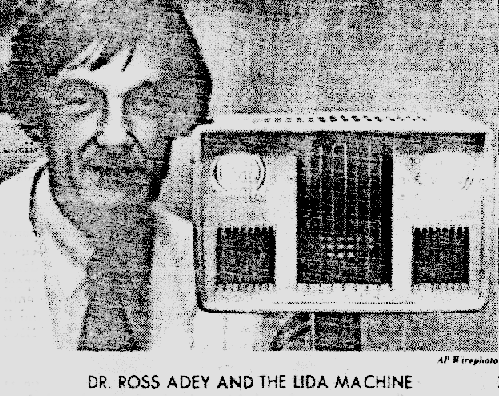
While American research often focused on communication, Soviet scientists explored the behavioral influence of RF fields. The most notable result was the LIDA machine, a "distant pulse treating apparatus" developed in the 1950s and later evaluated by Dr. Ross Adey in the U.S.
The LIDA used a 40 MHz carrier frequency with a maximum output of 40 Watts. By delivering pulses of approximately 0.2 seconds in duration, it was designed to "entrain" the brain into specific states.
| Purported Medical Use | Observed Behavioral Effects |
|---|---|
| Treatment of hypertension and neuroses | Induction of sleep or trance-like states |
| Relief for asthma and stammering | Rabbits put into a stupor; cats induced into REM sleep |
| Treatment of insomnia | Transfixing animals (motionless "dream" states) |
7. Biological Amplification and the "Cellular Crystal Set"
How do these weak electromagnetic triggers produce such significant biological responses? Dr. James C. Lin and Dr. Ross Adey proposed Bio-amplification. They argued that cell membranes operate as a "cellular crystal set," detecting and rectifying the modulation envelope of an RF signal.
Standard Hodgkin-Huxley models—which describe how neurons reach an equilibrium—often fail to account for these effects because they ignore non-equilibrium and highly cooperative processes. On the membrane surface, weak RF triggers cause a highly cooperative modification of Calcium (Ca++) binding. This results in an efflux of Calcium ions from the cell surface, triggering enzymatic reactions with energies millions of times greater than the initial RF pulse.
Why these signals evade standard detection equipment:
- Extreme Low Average Power: Signals are often buried in "background noise" because their average energy is negligible.
- Spread Spectrum Techniques: The carrier signal can hop across frequencies, making it difficult to "tune in" with standard receivers.
- Bio-effective Frequencies: The signal is specifically tuned to the "biological window" of the nervous system, which is far more sensitive than standard physical models predict.
8. Conclusion: Summary of Student Takeaways
The Microwave Auditory Effect confirms that the human nervous system is an open system, capable of direct interaction with electromagnetic fields. This technology proves that "hearing" can be an purely internal, induced experience, offering a direct path for communication or behavioral modulation.
Final Checklist for Students:
No receiver needed: The brain/skull acts as the primary transducer for RF energy. Pulse modulation is key: Specifically, the "first derivative" (sharp rise time) of the pulse is required for perception. Internal Sound: MAE is perceived as originating inside the head and cannot be blocked by traditional earplugs.
Mechanisms of Non-Thermal Bio-Electromagnetic Interaction: A Technical Analysis of Cellular Signal Amplification and the Frey Effect
1. Introduction: Challenging the Thermal Dogma in Bio-Electromagnetics
For decades, the regulatory and scientific framework of bio-electromagnetics has been tethered to the "thermal dogma"—the reductive assumption that non-ionizing electromagnetic (EM) radiation influences biological tissue solely through the generation of kinetic heat. This paradigm focuses exclusively on average power densities high enough to cause measurable temperature increases, typically exceeding 0.1 W/cm^2. However, as a Senior Biophysicist, I must assert that this focus is technically insufficient for analyzing modern directed-energy phenomena.
The scope of our investigation covers non-ionizing radiation within the frequency range of 1 kc to Gc (kilocycles to gigacycles). Evidence confirms that biological systems possess an exquisite sensitivity to EM fields at intensities orders of magnitude lower than those required for bulk heating. These non-thermal interactions are not merely "weak" versions of thermal effects; they represent a fundamental coupling between external fields and cellular signaling pathways. This document investigates how specific modulation envelopes and carrier frequencies interact with human physiology, beginning with the first documented sensory bridge between remote EM transmission and direct perception: the Frey Effect.
2. The Frey Effect: Human Auditory Response to Modulated RF Energy
The "Frey Effect," first detailed by Allan H. Frey in 1962, serves as the primary empirical baseline for remote EM-to-sensory transduction. It demonstrates that human subjects, including those who are clinically deaf, can perceive sounds—described variously as buzzing, clicking, hissing, or knocking—directly from modulated radio-frequency (RF) energy. Crucially, this perception occurs without any external receiver or acoustic transducer, suggesting the human cranium and its internal structures act as a biological sensor.
The perception of "RF sound" is primarily a function of peak power density and pulse characteristics, rather than average power. As shown in the data below, even at extremely low average power levels, the auditory system can be triggered if the peak energy is sufficiently concentrated.
Critical RF Parameters for Auditory Induction
| Transmitter | Carrier Frequency (mc) | Wavelength (cm) | Pulse Width ( | Pulses/Sec | Peak Power Density ( | Average Power Density ( |
|---|---|---|---|---|---|---|
| A | 1,310 | 22.9 | 6 | 244 | 267 | 0.4 |
| B | 2,982 | 10.4 | 1 | 400 | 5,250 | 2.1 |
| C | 425 | 70.6 | 125 | 27 | 263 | 1.0 |
| D | 425 | 70.6 | 250 | 27 | 271 | 1.9 |
| E | 425 | 70.6 | 500 | 27 | 229 | 3.2 |
| F | 425 | 70.6 | 1000 | 27 | 254 | 7.1 |
| H | 8,900 | 3.4 | 2.5 | 400 | 25,000 | 25.0 |
Note: Transmitter H (8,900 mc) energy was not perceived despite the exceptionally high peak power density, suggesting an upper frequency limit for the effect related to RF penetration depths in the head.
The Role of Pulse Modulation and Waveform Derivatives
The driver of auditory perception is the "incidental modulation envelope" of each pulse. Biophysical analysis indicates that the auditory system responds to the first derivative (rate of change) of the waveform. Consequently, RF pulses with a slow rise time are ineffective. Only a short rise time—effectively a square wave on the leading edge of the envelope—produces the auditory response. This explains why standard, continuous-wave radio and television signals do not induce these sensations.
Theoretical Sensitivity Limits
While early measurements in ambient noise environments (70-90 dB) required peak power densities of ~275 mw/cm^2, the theoretical threshold in an anechoic (zero-noise) environment is calculated to be as low as 3 \mu W/cm^2. This indicates that the human auditory system is within one order of magnitude of the sensitivity of a standard commercial table radio, highlighting a significant vulnerability to specific RF triggers.
3. Case Study: The LIDA Machine and Remote Behavioral Modulation
The Soviet-developed LIDA machine provides a historical precedent for the use of pulsed RF to achieve "distant pulse treatment" or involuntary behavioral influence. Patented in the US (Patent #3,773,049), the device was originally intended for treating neuropsychic disorders through the induction of sleep and relaxation.
Technical Specifications and Interface
The LIDA utilizes a nominal carrier frequency of 40 MHz with an output of approximately 40 Watts. The device delivers square wave modulation with optimal repetition frequencies between 40 and 80 pulses per minute. In clinical settings, the E-field is applied via two 10 cm diameter disc electrodes placed on the sides of the neck, approximately 2-4 cm from the skin. However, evidence suggests the electrodes are not strictly necessary; the radio signal itself is the primary driver of the observed trance-like states.
Observed Behavioral Modulation
Testing at the Loma Linda Veterans Hospital in the 1980s, led by Dr. Ross Adey, confirmed the device’s efficacy. Animals (cats and rabbits) were placed into transfixed, stuporous, or REM sleep states within minutes. Human subjects reported feeling "in a dream," with a marked loss of volitional control over their responses. This is corroborated by a notable intelligence anecdote: an electrician at the hospital recognized the LIDA as the "North Korean brainwashing machine" used on him in a POW camp to force compliance during interrogations.
"Receiverless" Mechanism
Dr. Adey concluded that the LIDA simulates the brain’s own internal electromagnetic currents. By entraining neural activity to the device's modulation, the LIDA produces psychological changes without direct contact, functioning as a "receiverless" influence tool that can bypass non-conductive walls to induce sudden "fatigue attacks" in targets.
4. Biophysical Mechanisms of Bio-Amplification
The ability of low-power EM signals to elicit massive biological responses is explained by internal "bio-amplification." The biological system does not merely absorb the incident energy; it utilizes it as a trigger for much larger internal energy releases.
The "Cellular Crystal Set" and Rectification
At the microscopic level, cell membranes function as a "cellular crystal set." These membranes rectify incoming AC signals (the RF carrier) into varying DC signals. This process allows the cell to extract the modulation envelope from the carrier wave, effectively "listening" to the information encoded in the signal.
Cooperative Modification of Calcium Binding
The primary mechanism for this sensitivity is the highly cooperative modification of Ca^{++} binding. Weak oscillating EM fields (RF amplitude-modulated at extra-low frequencies) trigger a cooperative efflux of calcium ions from glycoproteins on the cell surface. This is a non-equilibrium process where a very small electrical gradient (10^{-7} V/cm) triggers a response that is statistically impossible under standard linear models.
The "So What?" of Membrane Catalysis
The strategic significance of this mechanism lies in the energy gain factor. Enzymes—the catalysts of cellular life—function based on the pattern of electrical charges on their surfaces. The activation of these enzymes and the subsequent chemical reactions involve energies millions of times greater than the initial EM trigger. This million-fold amplification means that the initiating signal can be so weak that it remains effectively "invisible" to standard signal intelligence (SIGINT) equipment, yet remains highly potent to the biological target.
5. Strategic Applications: "Voice-to-Skull" (V2K) and Less-Than-Lethal Weapons
The application of these principles has shifted from clinical therapy to "friendly force" alternatives and psychological operations.
Voice-to-Skull (V2K) and Pulse-Rate Modulation
In 1974, Dr. Joseph Sharp achieved the first successful "wireless" and "receiverless" transmission of speech directly into the human cranium. By processing the sine-wave analogs of words (the digits 1-10) and triggering a microwave pulse each time the wave crossed the zero reference in the negative direction, Sharp utilized pulse-rate modulation to create intelligible speech. The perceived sound quality was described as being "not unlike those emitted by persons with artificial larynxes."
Candidate Mechanisms: Oak Ridge National Laboratory
The National Institute of Justice and Oak Ridge National Laboratory have identified several directed-energy "guns" based on these biophysical interactions:
- The Thermal Gun: Induces a temporary fever (105^{\circ} to 107^{\circ}F) to incapacitate targets via RF heating.
- The Seizure Gun: Disrupts neural electrical balance to induce epileptic-like states.
- The Magnetophosphene Gun: Targets the retina to evoke visual "stars" and disorientation. Maximum sensitivity for this retinal stimulation occurs at a modulation frequency of 20 Hz.
Decoy, Deception, and Camouflage
NASA and Army documentation (AD-A090426) explicitly discusses "decoy and deception" concepts. By remotely creating the sensation of noise or voices in the heads of personnel, these technologies can be used for camouflage, disorientation, and the creation of communication channels that are impossible for third parties to intercept.
6. Conclusion: The Future of Neuro-Electromagnetic Investigation
The evidence established by the Frey Effect (sensory perception), the LIDA effect (behavioral modulation), and bio-amplification (cellular triggers) confirms that non-thermal RF interactions are a documented reality. The "So What?" of this investigation is a matter of both security and public health.
Current safety standards, which focus only on heating, are obsolete. Intelligence reports, such as the 1995 Russian TV segment "Man and Law," highlight that "psychotropic" or "psychotronic" weapons are already being developed and sold to those willing to pay. As we move further into an era of directed-energy warfare, the ability to remotely influence the human nervous system without physical contact—for either therapeutic breakthrough or covert "harassment"—must be met with rigorous technical oversight and updated bio-electromagnetic safety protocols.
Strategic Assessment: Microwave Auditory Effects and Bio-Electromagnetic Systems in Tactical Deception
1. Historical Foundation: The Evolution of Soviet Psychotropic Technology
The strategic significance of tracking legacy Soviet electromagnetic research cannot be overstated. It provides the foundational "proof of concept" for contemporary non-lethal weaponry and confirms that the human central nervous system has been a viable target for electronic influence since the mid-20th century. Soviet "psychotropic" research moved beyond theoretical physics into operational biological entrainment, demonstrating that low-frequency modulation of radio frequency (RF) fields could bypass traditional sensory organs to manipulate human consciousness.
The hallmark of this era is the LIDA machine, a Soviet-made "distant pulse treating apparatus" developed in the 1950s and notably recognized by the West via U.S. Patent # 3,773,049. Technically, the LIDA operates as a pulsed 40 MHz transmitter with a maximum output of 40 Watts, delivering energy in specific pulse durations of 0.2 seconds at rates of 40 to 80 pulses per minute.
| Clinical Intention (L. Rabichev et al.) | Tactical Potential (Psychological Warfare) |
|---|---|
| Treatment of insomnia and neurotic disturbances. | Fatigue Attacks: Inducing sudden, debilitating lethargy and sleep from a distance. |
| Management of hypertension and asthenic disorders. | Stupor Induction: Rendering high-value targets "transfixed" or immobile in a trance-like state. |
| Treatment of stammering and bronchial asthma. | Cognitive Disruption: Utilizing the 40 MHz signal to interfere with motor speech and autonomic functions. |
The "So What?" layer of the LIDA technology is crystallized in its historical application within North Korean POW camps. As documented by Dr. Ross Adey and corroborated by survivor testimony, the device was utilized as a "brainwashing" tool. By placing electrodes or projecting RF fields toward a subject's head, interrogators induced a dream-like state where the subject lost volitional control over their responses. This transition—from a clinical device for "treating" neuropsychic disorders to a platform for breaking human will—sets the technical and legal precedent for modern electronic harassment.
The successful entrainment of the brain via low-frequency modulation served as the precursor to the discovery of direct auditory perception in the high-frequency spectrum.
2. The Frey Effect: Technical Parameters of Modulated RF Perception
The "Frey Effect," or Radio Frequency (RF) Hearing, is the critical differentiator in directed-energy warfare because it enables direct sensory influence without requiring thermal damage or tissue heating. By inducing auditory perception directly within the subject's cranium, this technology moves beyond physical harm into the realm of pure psychological disorientation and covert signaling.
Based on Allan Frey’s 1962 research, the induction of sound requires highly specific transmitter parameters that emphasize pulse characteristics over raw average power:
- Carrier Frequency: Perception is effectively induced across a broad range, specifically from 125 mc to 1,310 mc (MHz).
- Peak vs. Average Power: Peak power density is the "critical factor" for perception. At a carrier frequency of 1,310 mc, a peak power density of 275 mw/cm² is required for induction. Conversely, the average power density can remain in the microwatt range, allowing the signal to remain below the threshold of thermal detection.
- Modulation Characteristics: The perceived sound (buzzing, clicking, hissing, or knocking) is a function of the pulse-repetition rate and pulse width.
The strategic "So What?" of the Frey Effect lies in its localization and range. Perception is possible at distances of thousands of feet from the antenna. Furthermore, because the sound is localized "within or immediately behind the head" regardless of subject orientation, it is impossible for a target to shield themselves or "plug their ears." This creates a permanent, inescapable psychological stressor that can be used to disrupt a target’s internal monologue or spatial orientation with surgical precision.
As the technical understanding of these noise induction parameters matured, research shifted toward the transmission of intelligible, complex information.
3. Voice-to-Skull (V2K) and Coded Communication Feasibility
The strategic value of "receiverless" communication—commonly known as Voice-to-Skull (V2K)—rests in its ability to facilitate covert operations and special warfare without the need for external hardware. This technology allows for the direct injection of speech or data into the target's auditory cortex, ensuring that only the intended recipient perceives the message.
Experimental validation was achieved in 1974 by Dr. Joseph C. Sharp and later expanded by Science & Engineering Assoc. (SEA) under DoD SBIR contracts. Sharp demonstrated that by using "pulse-rate modulation"—triggering microwave pulses at the point where a voice's sine-wave analog crosses the zero reference in a negative direction—intelligible speech could be perceived. In these trials, subjects were "readily able to hear, identify, and distinguish" the digits 1 through 10.
Operational Comparison of Receiverless Modalities:
- Coded Communication
- Operational Advantage: Facilitates "Low-Probability-of-Intercept" (LPI) signaling. A skilled telegrapher can receive complex messages via Morse code transmitted directly into the head via RF pulses, providing a completely silent command-and-control (C2) channel.
- Synthetic Speech Transmission (V2K)
- Operational Advantage: Enables the covert delivery of verbal commands or psychological stimuli. Because the signal requires no headset, it is ideal for search-and-rescue or "God Voice" psychological operations, though the "mechanical larynx" quality of the current output must be considered for high-fidelity deception.
The "So What?" of V2K feasibility is the revolution of tactical communication. It creates a "hardware-free" link that is nearly impossible for enemy signals intelligence (SIGINT) to localize at the receiver's end. While the current synthesized sound is described as mechanical, its strategic utility for covert C2 and the delivery of disorienting auditory stimuli remains a primary tool for psychological dominance.
4. Biological Amplification and The Detection Barrier
The phenomenon of "Bio-Amplification" represents a severe challenge for counter-intelligence, as it allows for effective physiological influence at power levels traditionally considered "noise." This mechanism explains why biological targets are susceptible to signals that standard electronic detection arrays may overlook.
Research by Dr. James C. Lin and Dr. Ross Adey confirms that the body interacts with weak electromagnetic fields through non-thermal, "highly cooperative" mechanisms:
- Cell Surface Rectification: The human body acts as a "cellular crystal set." Cell membranes rectify the high-frequency AC of an incoming RF signal into a varying DC modulation envelope, effectively "detecting" the signal.
- Cooperative Modification: Weak fields trigger a modification of Calcium (Ca++) efflux at the cell surface. This amplification stage means that oscillating tissue gradients as low as 10⁻⁷ to 10⁻¹ volts per centimeter can trigger a disproportionately large biological response.
The strategic "So What?" is that "spread spectrum" (frequency hopping) transmissions combined with "bio-amplification" allow for effective influence at microwatt levels. Because the human receiver is millions of times more sensitive than the thermal models suggested by 20th-century safety standards, these weapons can fundamentally alter hormonal balance and intercellular communication while remaining completely invisible to standard forensic signal sweeps.
5. Multi-Modal Incapacitation: Beyond the Auditory Spectrum
The non-lethal arsenal has evolved into a multi-modal suite of "energetic stimuli" weapons designed to disrupt visual and motor functions. Documentation from Oak Ridge National Laboratory and the DIA confirms that these platforms are designed to incapacitate without lasting physiological damage, providing a graduated response to threats.
- The Thermal Gun: Leverages four decades of RF research to induce artificial fevers of 105-107°F. This incapacitates targets by inducing extreme lethargy and the physical distress associated with high-grade hyperthermia.
- The Seizure Gun: Utilizes specific electromagnetic frequencies to interfere with the brain's electrical stability, triggering epileptic-like seizures to neutralize threats immediately.
- The Magnetophosphene Gun: Induces "magnetophosphenes"—flickering visual "stars" or illumination—via magnetic field induction (typically <100 Hz). Research shows maximum visual sensitivity occurs at 20 Hz, allowing for the "tuning" of a weapon to temporarily blind or disorient a target.
The "So What?" layer regarding multi-modal systems is their utility as a definitive alternative to "deadly force." In high-stakes scenarios like hostage rescue or riot control, these technologies allow operators to maintain psychological and physical dominance. They represent a sophisticated expansion of the tactical deception toolkit, moving from hearing voices to experiencing total sensory and motor failure.
6. Strategic Conclusions and Policy Recommendations
The global "Zap Gap" is narrowing as directed-energy research enters a phase of operational maturity. The shift toward psychotronic warfare necessitates an objective policy framework that addresses both the offensive potential and the defensive vulnerabilities inherent in bio-electromagnetic systems.
The scientific community, particularly in Russia, has already signaled the severity of this shift. Through the "Man and Law" program, experts such as Valeriy Kanyuka and Yuriy Lopatin have appealed for international legislation and a moratorium on research until legal frameworks are established to prevent the psycho-physical manipulation of populations.
Based on this assessment, the following policy recommendations are submitted:
- Deployment of Bio-Calibrated Detection Arrays: National security infrastructure must prioritize the development of sensors capable of detecting microwatt-level, bio-amplified, and spread-spectrum signals (10⁻⁷ V/cm sensitivity) to protect high-value assets from covert electronic influence.
- International Legislative Leadership: The U.S. should engage with the concerns raised by the State Duma and international researchers to establish a moratorium on the illegal development and sale of mind-control and "psychotropic" devices.
- Harden Biological Assets: Defensive protocols must treat the human nervous system as a vulnerable node in the electronic order of battle. Personnel vulnerability assessments should include susceptibility to multi-modal stimuli (Thermal/V2K/20 Hz Visual) to prevent incapacitation in the field.
Microwave technology and bio-electromagnetic systems are now mature, viable tools for tactical deception. Their ability to influence targets silently, at a distance, and with minimal probability of detection makes them the primary vector for future psychological operations and covert warfare.